

Ticket Triage: Sort Support Tickets by What Expires First
Use this ticket triage guide to prioritize deadlines, assign capable owners, and test AI classification, field updates, handoffs, and completed actions.

In a first-in, first-out support queue, arrival time decides who gets help next. That can create a problem when a customer asks to change an address 10 minutes after placing an order, while another customer asks a general delivery question that can wait until tomorrow.
Ticket triage decides which support ticket needs attention first, who should own it, and what that person is allowed to do. In ecommerce support, priority often depends on a deadline outside the support team: the warehouse ship cutoff, an order’s fulfillment status, or a refund window. If the team misses it, a request it could have fixed may become a return, a reship, or a public complaint.
Use these six steps to triage tickets, assign the right owner, and test where automation needs human review.
Support ticket triage at a glance
The queue should not ask only, “Which ticket arrived first?” It should ask, “Which ticket becomes impossible to fix first?”
| Ticket | Clock that is running | If missed | Route to | Authority needed now |
|---|---|---|---|---|
| Change an address before shipment | Warehouse cutoff and fulfillment status | Return, reship, or failed delivery | Order-capable agent | Address correction or cancellation within the brand’s limit |
| Duplicate charge or refund not received | Payment and refund window | Escalation, dispute, or loss of trust | Billing-skilled agent | Refund verification; approval for exceptional compensation |
| Device cannot be configured | Customer’s usage window and promised response time | Repeat contact and avoidable return | Product-skilled agent | Troubleshooting; technical escalation inside the same contact |
| First “where is my order?” question | Carrier and promised delivery date | Anxiety, but usually still recoverable | Order-status queue | Tracking explanation |
| Second delivery question | Previous response and customer patience | Churn or complaint | Senior order-status agent | Proactive recovery within agreed limits |
| Night-time urgent request | The same external cutoff, despite local office hours | Morning backlog and a missed cutoff | Active shift or follow-the-sun team | The handoff must include red-line rules and limits |
An immediate threat to safety, security, or account access needs its own urgent escalation. For the remaining queue, compare consequences and deadlines before using arrival order to break a tie. Ticket volume matters for staffing, but this page does not estimate it; use the ticket volume guide, and for phone queues the Erlang calculator turns call volume into a headcount.
How triage differs from ticket routing
Triage is the review before someone starts work on a ticket. Check what the customer needs, how urgent it is, what happens if it waits, when action is due, and who has permission to finish the job. Ticket routing then sends it to the right queue, skill group, or human agent.
| Triage | Ticket routing | |
|---|---|---|
| Main question | How soon must someone act, and what outcome is at risk? | Which queue or skill group should receive it? |
| Output | Priority, deadline, category, escalation level, authority | Assigned queue, language, product, or agent |
| Typical failure | Treating every request as FIFO | Sending an urgent ticket to a team that cannot finish it |
| Timing | Before normal work begins | After enough information exists to assign ownership |
In a help desk, triage decides the order and the owner; routing delivers the ticket to that owner’s queue or skill group. A team can route every ticket correctly and still fail if it triages them in arrival order.
Common routing methods include fixed rules for known requests, skill-based matching for language or product expertise, round-robin distribution, and workload-based assignment. Use the latter two after priority and required authority are established. In a phone queue, an IVR choice can identify the broad request; someone still needs to assess the deadline and consequence of waiting.
Customer and IT queues can run on different clocks
Both IT and customer service teams need to consider service impact, risk, and time. An IT outage can have an external business deadline too. In customer service, add fulfillment, payment, and carrier events to the internal response-time target when triaging tickets.
Shopify’s order-editing documentation gives one concrete limit: an authorized person can edit unfulfilled items but cannot remove fulfilled items or change their quantity. This is a line-item rule; an address change also depends on the store and fulfillment workflow. Check both systems before promising that a change will reach the shipment.
Build an external-clock table before setting priority labels:
| External clock | Who controls it | What missing it creates | How to set the support target |
|---|---|---|---|
| Warehouse pick, pack, or ship cutoff | Warehouse or 3PL | Address correction becomes a return or reship | Target response before the cutoff, with buffer for verification |
| Order fulfillment status | Store and fulfillment system | Some order fields are no longer editable | Show status to the agent before the agent promises a change |
| Refund or payment review window | Payment provider and brand policy | A preventable dispute or delayed refund | Route billing requests to someone who can verify the transaction |
| Carrier handoff or delivery exception | Carrier | More expensive recovery and repeat contacts | Escalate exceptions before the next carrier event |
| Promised reply time | Brand, marketplace, or contract | SLA breach and loss of trust | Treat it as the internal floor, not the only urgency signal |
Set SLA targets by working backward from the outside deadline. First find the event that would make the request impossible to complete, then leave enough time for the team to check and handle it. A “high priority” label on its own doesn’t tell anyone when to act.
The triage process in six steps
1. Tag the request on arrival
Capture the reason, product, order status, language, customer history, and channel. Add red-line phrases such as “change address,” “wrong address,” and “cancel order” before the request enters the ordinary queue.
Use keyword rules to flag a request for attention, then have a human reviewer check what the customer means. “Cancel my subscription” and “I cannot cancel the order” may need different owners even though both mention cancellation.
When one customer writes on chat and email about an order, review the two conversations before deciding whether they concern the same problem. Link the relevant history and check identity, issue and ownership before merging. Separate requests on one order may need different owners.
For an example of maintaining those fields as a conversation changes, see the HeroDash AI agent assist walkthrough, including human corrections and manual reanalysis.
Collect enough information to assign the next action.
For an illustrative product-fit request, collect the order reference, purchased item, relevant model details and any photograph the specialist actually needs. Preserve information already provided. An urgent safety concern or a cancellation cutoff should reach the appropriate person while missing details are gathered; a form must not hold up that escalation.
AI ticket triage can prepare a record by finding a possible repeat contact, suggesting field values, or assigning a queue. Each operation needs a separate check. None establishes permission to merge cases, approve a refund, or close an unresolved request. The evaluation record below separates these outputs from the final action.
For order lookups and failed-query examples, use the ecommerce chatbot evaluation guide. Keep the reference, the attempted action and the unresolved question together when the case moves to a person.
2. Set priority from the expiring clock
Set priority by what will happen if the customer waits. Capital letters or an old ticket can draw attention, but neither tells you whether a shipment, payment, or safety issue needs action first.
| Level | Priority basis | First reply target | Evidence to check |
|---|---|---|---|
| P1 | Immediate safety/security risk or an imminent high-consequence event | Urgent skilled escalation; act within the relevant deadline | Risk, affected customer, system or fulfillment state |
| P2 | Money or access issue without immediate danger | Target based on impact and the next deadline | Payment record, account state, required permission |
| P3 | Customer has already contacted support once | Faster than the previous cycle | Previous reply, unresolved status, sentiment |
| P4 | Routine information request | Standard SLA | Order status and knowledge base |
Record the deadline behind each target.
def response_target_minutes(cutoff, verification, handling, buffer):
    """Work backward from the external cutoff."""
    return cutoff - verification - handling - buffer
3. Route to the queue or skill group that can finish it
Send the ticket to someone with the skills and permission to complete the next action. Speaking the customer’s language won’t help someone change an order they can’t access. A product specialist who can’t authorize a refund will also need help. Check those requirements before using open-ticket counts to choose the owner.
Useful assignment fields include language, product line, order state, issue type, customer tier, and required permission. Keep the output visible: the next owner should see why the ticket is urgent and what action is expected.
4. Escalate inside the contact, not after it
An escalation that sends the customer away creates another contact and resets the explanation. When possible, a senior specialist should listen in, whisper guidance, or join the call while the original owner stays with the customer.
For messages, keep the owner visible, add the specialist internally, and return one coherent answer. Triage should reduce handoffs, not merely count them.
When AI hands a request to a person, review AI escalation logs and billing boundaries alongside the routing rules.
5. Resolve with authority agreed in advance
Write down what frontline staff can do without waiting: resend a part, correct an order field, issue a refund below a limit, or offer a defined recovery option. The brand sets the policy and the financial limits; the service team operates inside them.
Set approval limits according to what could go wrong. Actions involving money, legal rights, account access, privacy, or safety need explicit review and escalation rules. A classification score alone cannot grant that authority.
6. Close, tag the outcome, and review the rules
Record the result, not only the action: corrected before shipment, shipped before correction, refunded, transferred, solved in the first contact, or awaiting a customer reply. Review the assignment rules when products, teams, fulfillment partners, or hours change.
Repeated reassignment is a useful diagnostic. When a ticket moves between teams, record the reason: missing skill, missing permission, incomplete order context, or a changed customer request. That tells the lead which rule to review.
The flow should look like this:
Customer request
      ↓
Keyword and context check
      ↓
External clock + impact → priority queue
      ↓
Skill, language, product, and permission route
      ↓
Frontline agent resolves or senior agent joins the same contact
      ↓
Outcome tag → rule review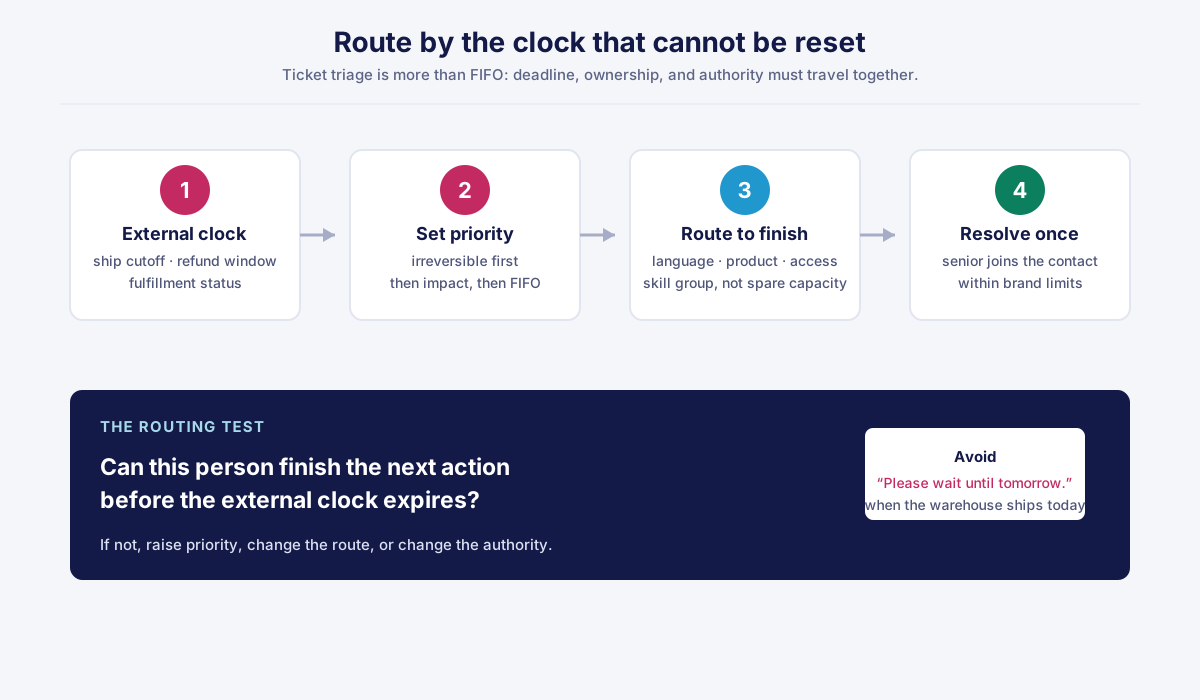
What this looks like in practice: FRT, then FCR, then CSAT
Callnovo’s published smart-mower case account describes an unnamed client. The figures below describe that account; the publication does not specify the measurement period or sample size.
During a promotion, an address-change email arrived after the phone team closed and was read after the warehouse had prepared the shipment. A later setup problem led to another promised callback. Callnovo.ai introduced priority rules for address changes and cancellations, follow-the-sun coverage, and same-contact technical escalation. The published account reports these results:
| Measure | Before | After |
|---|---|---|
| First response time | 16 hours | Under 20 minutes |
| Wrong-address orders corrected before shipment | — | More than 95% |
The brand also defined first-contact reship and compensation limits so frontline staff could act within those limits. The case account describes the customer later posting positively about support. For another example of a supervisor helping during a call, see the office-chair case study.
Track first response time (FRT), first-contact resolution (FCR), and customer satisfaction (CSAT) separately. A faster acknowledgment can improve FRT while leaving the issue unresolved. Review the actual order or account outcome alongside those measures.
Manual, rule-based, or AI triage: what each one catches and misses
Manual review, rules, and AI classification catch different problems. Choose each method for the mistakes it can prevent, then decide which actions still need a person’s approval. Classifying a request shouldn’t give an unreviewed system permission to make a consequential decision.
| Method | Catches well | Misses or risks | Best use |
|---|---|---|---|
| Manual | Context, exceptions, emotion, unusual requests | Night gaps, inconsistent memory, slow first review | High-consequence exceptions and final judgment |
| Rule-based | Exact phrases, order states, known channels | Wording variants and ambiguous context | Red-line triggers and stable routing |
| AI classification | Paraphrases, intent, language, multiple signals | Confident misclassification and unclear accountability | Suggesting category, priority, or destination for review |
Rule-based triage may catch “change my address” and miss “I typed the wrong street.” AI classification may catch the variant. Let automation classify and route; human agents approve refunds and reships within brand-defined limits.
Use the consequence of an error to set the review requirement. A wrong tracking explanation, an unauthorized refund, and a missed safety escalation need different controls even if the model gives them the same confidence score.
In HeroDash, documented assignment rules use the first matching rule and account for human agent availability, enabled channels, and capacity. Those settings determine where work can go; they do not prove that a model classified it correctly or that a human agent completed an action. Internal notes can preserve the reason for escalation and the next step. Voice tools include listen, whisper, and barge-in for same-contact help. Teams can compare pricing, multilingual support, and pay-per-resolution delivery against their required coverage and authority limits.
Test automated ticket triage before changing the queue
Test a ticket triage process against the work the receiving team can actually complete. Start with historical requests that qualified reviewers label independently, resolve disagreements against the policy in force, and keep a separate test set out of rule or model tuning. Include short messages, multiple requests in one message, repeat contacts, and cases the system should send for human review.
The NIST AI Risk Management Framework, Measure 2 calls for documented test sets and metrics, evaluation under deployment-like conditions, and production monitoring. It provides a testing framework, not a call-center accuracy target or a universal confidence cutoff.
Keep prediction, assignment, and completion separate
Use a record like this for each test. The row describes what to verify, rather than claiming that a particular product stores every field automatically.
| Check | Evidence to keep | A failure it can expose |
|---|---|---|
| Reference judgment | All requests, correct owner, deadline, permitted action, policy version | Reviewers disagree about what the customer needs |
| Model prediction | Predicted intent, priority, destination, confidence if available | A confident order-status label misses a cancellation |
| Written fields | Actual values after the update, with any human correction | A correct suggestion never reaches the ticket |
| Receiving owner | Assigned team, availability, acceptance or fallback record | The right queue has nobody able to act |
| Customer action | Verified system result, time, unresolved reason | A ticket is closed although the order was never changed |
For example, “Where is my order? Cancel it if it hasn’t shipped” contains a lookup and a conditional cancellation. A high-confidence WISMO label is incomplete if it hides the second request. Verify the fulfillment state and cancellation permission, then record the actual result. Treat a confidence score as a model output until its relationship to errors has been tested on your own cases.
Count missed urgent requests as well as false alarms
Here is a hypothetical test, using invented counts to show the calculation. Reviewers identify 40 genuinely urgent requests. The system flags 50, of which 32 are genuinely urgent.
| Measure | Calculation | Result |
|---|---|---|
| Precision: how many urgent flags were correct? | 32 ÷ 50 | 64% |
| Recall: how many genuinely urgent requests were found? | 32 ÷ 40 | 80% |
| False alarms | 50 − 32 | 18 |
| Missed urgent requests | 40 − 32 | 8 |
That test would leave eight urgent requests unflagged. Review their consequences before accepting the system, even if overall classification accuracy looks high. Inspect confident mistakes as well as low-confidence cases, and report results by intent, language, and risk where the sample supports it.
Run a shadow pilot first: keep the current queue working while reviewers compare suggested routes with actual handling. Record extra review work and reassignments. Before a limited rollout, name the person who can restore the previous rules, define the failures that trigger rollback, and check whether the receiving shift has capacity. Repeat the relevant tests after policy, model, or integration changes.
Who triages at 2 a.m.? Handing triage to another shift or an outsourced team
Give the overnight team the rules that make a ticket urgent, along with its queue login. They need to know the deadline, who can act, and which decisions need approval, just as the daytime team does.
The smart-mower case shows why the same deadline rules must apply overnight: an email that waits until the next local shift can miss the warehouse cutoff. Use your own hourly arrival pattern and missed-cutoff records to decide which hours need coverage.
| Handoff item | If it is missing | Confirmation owner |
|---|---|---|
| Red-line keyword list | The overnight agent treats an address change as ordinary work | Operations lead and brand owner |
| External-clock rules | Priority becomes a personal judgment call | Fulfillment and support leads |
| Order and fulfillment visibility | The agent promises a change that the platform no longer allows | Systems owner |
| Language and product skill map | The ticket reaches someone who can answer but cannot finish | Workforce and training lead |
| Refund, reship, and compensation limits | The agent either over-acts or tells everyone to wait | Brand owner |
| Escalation contact and response window | “Please wait until tomorrow” becomes the default answer | Senior support owner |
The team can be internal or outsourced. Callnovo.ai supports human-agent service across 65+ languages with follow-the-sun coverage. Confirm which hours, skills, and authority limits apply to your program.
Triage checklist + three questions to ask yourself
Use this checklist before changing a queue or buying an automation feature:
- Have we listed the external events that make a request harder or impossible to fix?
- Do address changes, cancellations, payment changes, and safety issues have explicit red-line triggers?
- Does the agent see fulfillment, payment, and previous-contact context before replying?
- Is each priority target calculated backward from a real clock?
- Does routing reach someone with the language, product skill, system access, and authority to finish?
- Can a senior specialist join the same contact instead of making the customer start over?
- Are refund, reship, and compensation limits written down and confirmed by the brand?
- Does the night or outsourced shift receive the same rules and escalation contacts?
- Are outcome tags recorded so repeated reassignment and missed cutoffs can be reviewed?
- Have we measured missed urgent cases, false alarms, and confident errors on a separate test set?
- Does a test record distinguish prediction, written fields, accepted ownership, and the completed action?
- Can a named owner restore the previous rules if the rollout fails?
Then ask three questions:
- How many change-of-address tickets last week were first answered after the order shipped? If nobody can answer, the triage process is not looking at the external clock that matters.
- When a frontline agent cannot finish a technical case, does the customer stay in the same contact while a specialist joins? If not, the escalation rule is adding a second contact instead of protecting first-contact resolution.
- Could the night-shift agent issue the agreed reship or refund without waking someone up? If not, the coverage is open after hours but the authority is not.
Triage works when the ticket reaches someone who knows how soon to act and has the authority to take the next step. If priority, ownership, and authority send it to three different queues, redesign the rule so the team can finish the work.
References
- Shopify Help Center, Considerations for editing orders.
- NIST, AI Risk Management Framework 1.0 — Measure 2, 2023.
- Callnovo, Smart-mower support case: response, escalation, and authority, September 11, 2026.
- Callnovo.ai, Office-chair support case.
Questions buyers ask
- What is ticket triage?
- It is the review step between a support request arriving and a staff member working on it. The team identifies the issue, urgency, impact, deadline, owner, and required authority. Good triage prioritizes the request whose consequences become irreversible first, rather than processing every ticket strictly by arrival time.
- What is a common mistake in ticket triage?
- A common mistake is treating first in, first out as a complete priority rule. FIFO ignores external deadlines such as a warehouse ship cutoff, and it can send a change-of-address request behind a routine delivery question. Use arrival order only after deadline, impact, skill, and authority have been considered.
- What is automated ticket triage?
- Automated triage uses rules or machine classification to identify a ticket's likely intent, priority, language, department, or destination. It is most useful for surfacing patterns and routing requests consistently. It should not automatically approve a refund, reship, compensation, or other high-consequence action unless the brand has explicitly defined and limited that authority.
- Can AI-based ticket triage replace human agents?
- AI-based triage can reduce manual classification and route routine requests, but it does not replace human judgment for ambiguous or high-consequence cases. A safer operating model lets AI suggest the category and destination while a human verifies context and acts within brand-defined limits for money, access, privacy, safety, or fulfillment changes.