

Answering Service: Live, AI or Hybrid Call Handling
Choose a live, AI or hybrid answering service. Compare call routing, after-hours coverage, booking permissions, human handoffs and the costs in your quote.
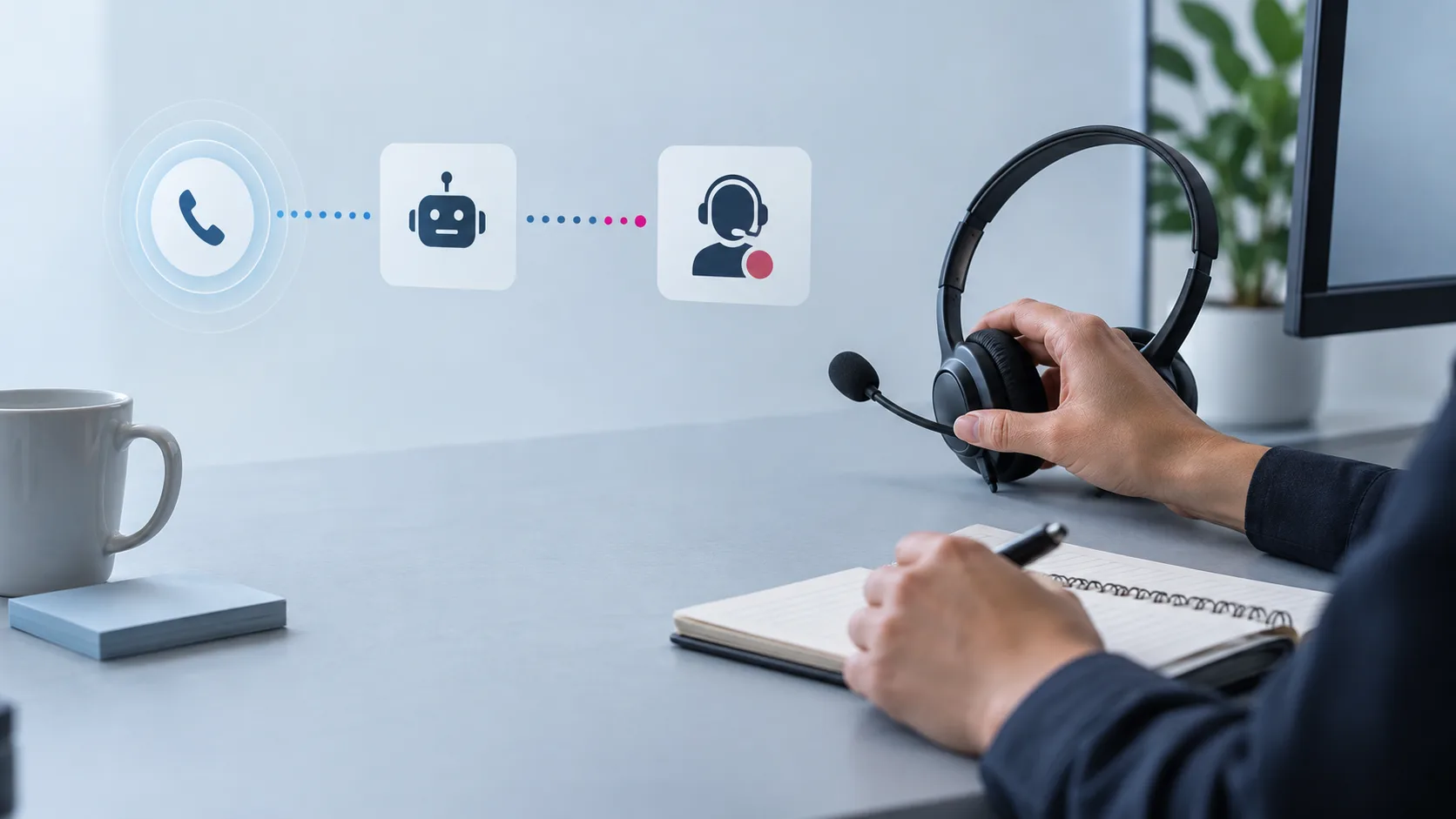
An answering service receives business calls, captures the information your team needs, and follows the call-handling rules you approve. A live answering service supplies people; an AI receptionist handles configured requests; a hybrid model connects the two. The useful comparison is what happens after the greeting: what gets recorded, what actions are allowed, and who owns the work still open.
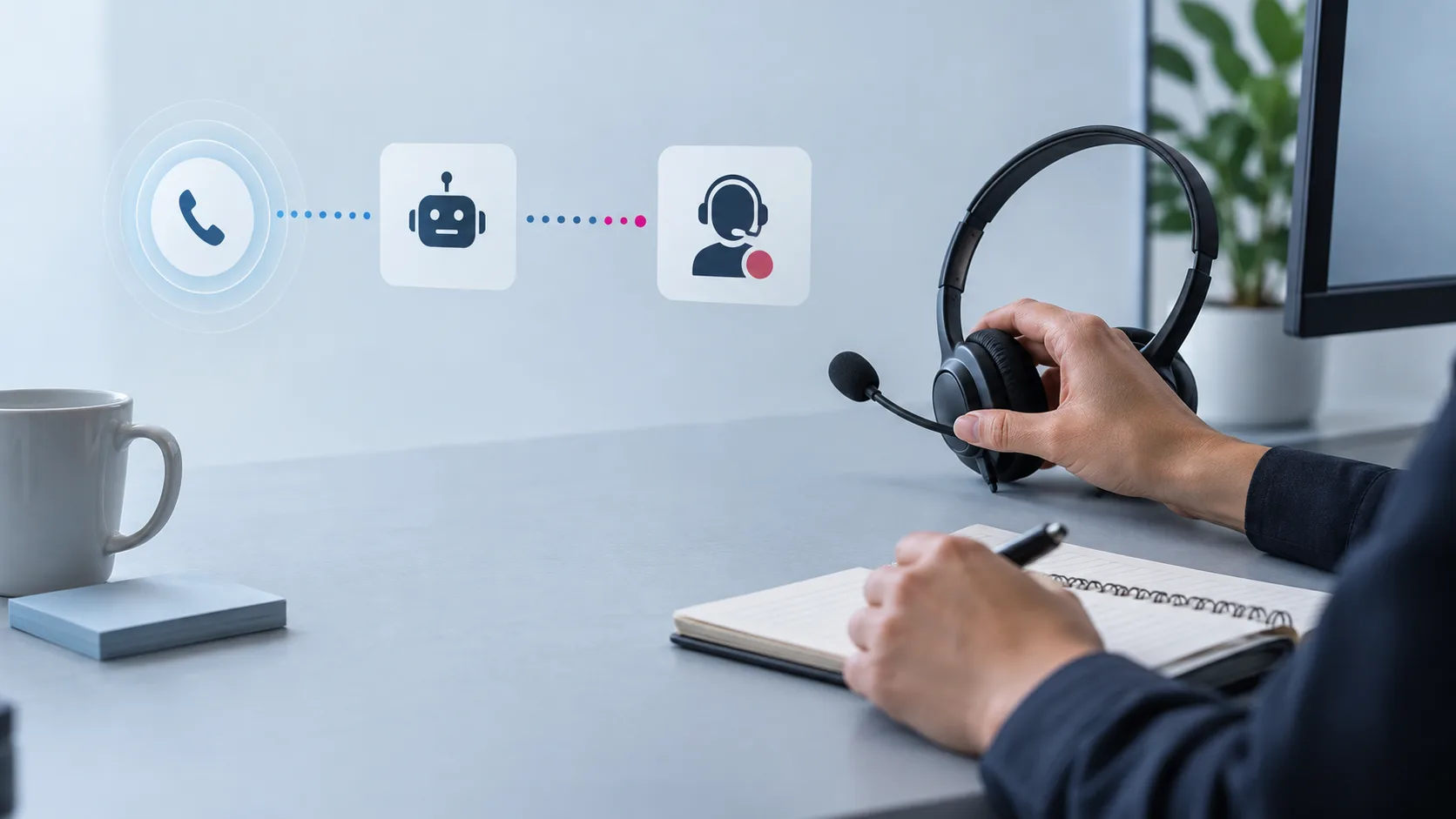
Choose Live, AI or Hybrid Answering
Define the work before choosing a model
This operation handles some or all of a business’s inbound calls. Depending on the agreed workflow, the team may greet callers, identify the reason for the call, take a message, schedule or change an appointment, provide an approved answer, create a ticket, transfer the call, or escalate it to a person inside the business.
That definition matters because “answering calls” can describe very different purchases. A message-taking service may only record the caller’s name, number, and reason for calling. A managed operation may follow scripts, verify information, update a system, and send urgent cases to an on-call person. An AI receptionist may handle routine questions first and transfer exceptions to an operator.
The scope should be written before a provider starts. At minimum, define:
| Decision | What to specify |
|---|---|
| Coverage | Hours, holidays, languages, channels, and supported numbers |
| Call handling | Greeting, identity checks, questions agents may answer, and actions they may complete |
| Recording | Caller details, reason, urgency, appointment window, and required notes |
| Routing | Queue, skill group, transfer rule, callback owner, and escalation contact |
| Control | Knowledge-base owner, script owner, quality reviewer, and access permissions |
A telephone answering service needs this scope even when the initial task is simply taking messages. It makes the receiving team and the promised next step clear.
Compare the operating models
| Model | Work to evaluate | Dependency to confirm |
|---|---|---|
| Live answering | People answer, take messages, follow approved workflows and manage exceptions | Training, system access, staffed hours and escalation authority |
| AI receptionist | Configured answers, intake, approved data lookups and routing | Current knowledge, tool permissions, reliable entry points and a fallback |
| Hybrid answering | AI handles selected work and passes exceptions to people | Human handoff context, receiving hours, language and callback ownership |
A virtual receptionist may screen calls, collect details or help with scheduling. Ask which of those tasks the proposed service actually includes. The name alone does not establish the staffing or permissions.
Live agents are useful when judgment matters
People are generally the better fit when the call requires context across systems, empathy during a complaint, language nuance, exception handling, or a decision that depends on company policy. Human support is also useful when the business wants a trained team to follow a detailed script and escalate according to a named list.
Agents need the information and permission to complete the next step. Keep their knowledge current and define how they reach the person who can authorize an exception.

AI is useful when the rules are stable
AI answering is worth evaluating for routine status questions, basic information, appointment requests and simple routing, when the required knowledge and permissions are available. The setup still requires a knowledge base, prompt or response rules, a voice configuration, a maximum call or timeout policy, an ending strategy, and a connection between the AI instance and the phone number or entry point.
Creating an AI voice assistant is only part of setup. In Callnovo’s telephone configuration workflow, the assistant must also be connected to the service number or inbound entry point. Test that connection before routing customer calls to it.
For a deeper comparison of AI-first voice platforms and handoff behavior, see Best Voice AI Platforms 2026. For workflows that need explicit trigger rules and human ownership, see AI-led escalation handling.
Hybrid models handle the boundary between routine and exceptional
A hybrid model uses AI for predictable work and people for context, judgment, or exceptions. The handoff should carry enough context for the next person to continue without reconstructing the whole call.
At minimum, define the handoff payload:
- caller identity and contact details;
- reason for the call and relevant classification;
- information already checked;
- action already attempted;
- rule that triggered the escalation;
- person, queue, or team responsible for the next step.
For a human handoff, also name the receiving team and its staffed hours. A summary helps an available person continue the conversation. When the queue is closed, the caller needs the agreed message or callback path. The NIST Generative AI Profile recommends defining the responsibilities of people and AI; for this workflow, that includes who receives an exception and who can authorize the next action.
Follow a Call from Greeting to Resolution
Map a call from the number dialed to the person responsible for the next action. The implementation can vary, but each step should have a clear record and owner.
1. The call enters a number and queue
Confirm how calls reach the service: call forwarding from an existing number, a hosted service number or another approved entry point. Keeping or moving a number depends on the country, carrier and proposed setup. Test the actual inbound route and the associated business line, language and hours.
2. The caller is identified and classified
The greeting should establish which business or team the caller reached. The next step is not always a full conversation. It may be a short classification: sales, support, appointment, existing customer, delivery issue, emergency request, or callback.
For lead capture, the information recorded should match the next action. A callback queue may need a name, number, preferred time, reason, and account identifier. A dispatch workflow may need location and urgency. For legal intake, use the law-firm intake page to scope the caller questions, permitted information and escalation rules.
3. The call follows a transfer rule
Call routing can use a queue, keypad choices and skill groups. A business may separate sales and support, English and Spanish, or routine questions and urgent cases. The transfer rule should name the destination and the fallback when nobody is available.
4. The agent or AI performs only approved actions
An agent may answer a published FAQ, create a case, schedule an appointment, or record a request. It should not invent a policy, approve an exception without authority, or make a medical, legal, or safety judgment on behalf of the customer.
The same boundary applies to AI. Start with stable answers and repeatable workflows where an incorrect action would have limited impact. The business still needs a rule for uncertainty, repeated failure, sensitive information, and a caller who requests a person.
5. The outcome and next owner are recorded
“Answered” is not the same as “handled.” A useful record says what the caller wanted, what was checked, what action was completed, what remains open, and who owns the next step. Check the receiving record and any completed system action. A transfer or a ticket marked Resolved does not by itself verify that the caller’s problem was solved. These checks also make quality review and repeat-contact analysis useful.
Set After-Hours and Overflow Coverage
After-hours coverage needs a separate plan for the first answer and the next owner. AI availability does not establish that a live team is staffed at the same time. Overflow during a busy afternoon can also need a different routing rule from a closed office at night.
| Call condition | Agree before launch | Check in a test call |
|---|---|---|
| Your team is busy | The overflow trigger and the team or AI route receiving the call | The call reaches the intended route without losing the caller’s details |
| Your office is closed | What the first handler may answer or record | The greeting states the next available action accurately |
| A person is needed | The live answering window, language and receiving queue | A staffed person accepts the transfer with useful context |
| Nobody can accept | An approved message, ticket or callback process and its owner | The record reaches that owner; the caller is not promised an unavailable transfer |
Set holiday and time-zone rules alongside normal hours. Platform technical support hours are a different service from the agents handling your customers. For a detailed staffing discussion, use the after-hours answering service page.
Connect Booking, Messages and Your CRM
Appointment scheduling is a chain of actions. Taking a preferred time is useful intake, but it does not prove that a slot was available or saved. Define how far the answering service may go and how the receiving system confirms each step.
| Task | Required access or information | Evidence of completion |
|---|---|---|
| Take a message or capture a lead | Approved contact fields, reason for calling and next owner | A saved record with the agreed callback or follow-up destination |
| Read availability | Access to the relevant calendar, service type and time zone | Available times returned by that system |
| Make or change a booking | Explicit write permission and rules for the permitted action | The saved entry and booking identifier match the caller’s request |
| Record a CRM update | Approved fields and matching rules for the correct customer | The intended record contains the update, without an unintended duplicate |
| Handle a failed connection | A defined retry or human follow-up route | An open request with an owner, rather than a false success message |
CRM integration should specify the system, the records the service may read and the fields it may change. An integration label does not grant every action in that CRM. For lead capture, agree which details are necessary and who follows up when the caller cannot be connected.
The FTC’s business security guidance recommends limiting access according to business need and setting security expectations for service providers. Apply that principle to the answering workflow: grant the access needed for the task and document the provider’s responsibilities. Test with non-sensitive sample records before exposing customer data.
Understand Answering Service Costs
A call answering service may be priced by minute, interaction, productive hour or monthly staffing. Some AI projects use a separately contracted outcome model. Compare the unit together with the included work. Our answering service pricing comparison prices one month of calls under each unit.
| Pricing unit | Questions behind the number |
|---|---|
| Per minute | Are waiting, transfers, recording, and carrier costs included? |
| Per interaction | Are follow-ups and reopened conversations included? |
| Productive hour | Does the price include supervision, QA, training, and coverage gaps? |
| Monthly team | What happens when volume is below or above the planned capacity? |
| Contract-defined outcome | How is success verified, and when does a reopened issue produce a credit? |
For Callnovo.ai, use the current pricing page to scope dedicated team support and multilingual support. Include live answering hours and after-hours coverage in the request. An AI receptionist quote should identify the applicable bot product, usage unit, minimum charge, carrier fees and separately staffed human work.
Under HeroDash’s AI billing rules, substantive AI work can incur usage charges even if the call later transfers to a person. A verified outcome is a separate contractual model, not a synonym for a call answered or a ticket closed. Ask how pay-per-resolution support is defined for the proposed project before comparing it with a per-minute rate.
Compare the same work, including transferred calls and follow-up. Ask which supervision, training and incomplete-record handling stays with your team. Then request a sample calculation using the same monthly call volume and call mix from each provider.
Choose a Setup for Your Business
Compare providers using the same call path
Use the same questions for every provider. The answers should describe an operating model, not just a feature list.
| Area | Questions to ask |
|---|---|
| Coverage | Which hours, holidays, languages, and numbers are included? |
| Script | Who writes, approves, and updates the greeting and decision rules? |
| Permissions | What can an agent view, change, schedule, refund, or submit? |
| Escalation | What triggers a transfer, callback, urgent alert, or internal handoff? |
| Systems | Which CRM, ticket, calendar, or knowledge base does the team actually use? |
| Quality | Who reviews calls, how often, and how are recurring failures returned to the script? |
| Reporting | Can the business see volume, reason, transfer, callback, repeat-contact, and outcome data? |
| Exit | How are recordings, notes, open cases, and workflow documentation returned? |
For a useful demonstration, give each provider the same caller request. Follow call routing to the final record and inspect the handoff or appointment scheduling result. Agree the human handoff owner, covered hours and exceptions before comparing the price.
Start from the work you need covered
Choose the next step from the work your callers need completed.
- Need routine AI reception with a planned human handoff? See AI reception with human backup.
- Need nights, weekends, holidays, or emergency rules? See after-hours phone coverage.
- Need English and Spanish in one queue? See bilingual phone support.
- Need to know whether the model fits a small operation? See small business phone support.
- Need legal intake, existing-client routing, or no-legal-advice boundaries? See law-firm intake support.
- Need broader customer service across phone, chat, email, and ticket workflows? Start with customer service outsourcing.
- Need call rules written for your industry? See the industry pages for medical practices, dental offices, real estate agents, property managers, HVAC companies, plumbers, roofing contractors, electricians, and pest control companies.
If you need software for your own agents, evaluate the cloud call center platform. If you need a team to operate the service, discuss customer service BPO outsourcing.
When to start with a smaller workflow
If policies, ownership or permissions are unclear, prepare those foundations first. Calls that depend on an undocumented specialist decision also need a defined internal escalation path before a provider can handle them consistently.
In those cases, start with a limited workflow. Choose one queue, one language, one customer segment, or one after-hours window. Write the actions and escalation rules, test the record and handoff, and review repeat contacts before expanding. A smaller pilot creates a reversible decision instead of a large commitment based on a forecast.
Where Callnovo.ai fits
Callnovo.ai provides human support in 65+ languages, alongside AI voice and managed support workflows. The exact fit depends on whether the business needs routine information, human judgment, language coverage, after-hours routing, or a wider customer service operation.
Describe a representative call path: the number or queue, the caller’s goal, the information agents may use, the actions they may complete, the escalation contact, and the record the business expects afterward. That path can then be matched to the appropriate product or managed support model. If you need to discuss a real queue, use the contact page or request a quote after reviewing the published pricing.
Sources and further reading
Questions buyers ask
- What is an answering service?
- An answering service receives business calls, captures the required information, and routes or completes the next approved action. It may use operators, AI, or a hybrid model, with the scope defined by the caller journey, system access, approved actions, and escalation rules.
- How does a virtual receptionist differ?
- Answering service is the broader term. A virtual receptionist usually focuses on greeting callers, screening calls, taking messages, call distribution, and sometimes scheduling. The exact boundary depends on the provider’s workflow, system access, escalation rules, and permissions.
- Can this type of service book appointments?
- Appointment scheduling depends on the approved calendar connection and the actions it permits. Collecting a preferred time, reading availability and writing a booking are separate steps. Confirm the resulting calendar entry and booking identifier before telling the caller an appointment is booked.
- Is AI reception enough for every business?
- No. AI is a better fit for stable, repeatable, lower-risk requests with clear approved answers. Calls involving exceptions, complex context, complaints, sensitive information, or policy judgment usually need an operator or internal specialist who can own the next decision.
- How much does this model cost?
- It depends on the billing unit, coverage window, language, call volume, systems and human escalation work. Ask for the same call mix to be priced, including minimum charges, overages, carrier costs and any staffing fees. AI usage and a contractually verified outcome are different billing models.
- What should I ask before choosing a provider?
- Ask what the team can do, what it can access, how it records the call, who owns the next step, how quality is reviewed, how exceptions are escalated, what the price includes, and how the workflow is returned if the relationship ends.