

Live Chat Outsourcing: Compare Cost, Coverage & Fit
Live chat outsourcing can add trained agents without building an in-house queue. Compare service models, pricing, coverage and a practical provider pilot.

Live chat outsourcing lets a business hire an outside team to answer website or in-app chats instead of staffing every conversation in-house. The provider may supply agents, supervision and quality reviews; your company still sets the product rules, approves system access and decides which issues agents may resolve.
The right option depends on the work in your queue. A small team answering store hours and basic product questions needs a different setup from a SaaS company handling account access or technical troubleshooting. Compare what a provider will do, when a trained person will be available, and how the service is billed before comparing headline prices.
What are you buying when you outsource live chat?
An outsourced live chat service can be a pool of agents shared across clients, agents assigned to your account, or an existing in-house team with an outside provider covering specific hours. Some providers also combine chatbots with human agents. These models are not interchangeable.
| Service model | What it usually means | Questions to settle |
|---|---|---|
| Shared agents | A provider’s team answers chats for more than one business | How are chats prioritized? What requests are in scope? Is a monthly allowance or response window included? |
| Dedicated agents | Agents are assigned to your account | What shifts are covered? Who fills absences? How much training and supervision is included? |
| Overflow or after-hours coverage | Your team handles some hours; a provider covers agreed gaps | Which queue receives the chat? What happens if the handoff arrives when your team is offline? |
| AI with human support | Automation handles approved routine work and routes other requests to people | What can the bot do? Does the agent receive the conversation history? Who is billed if the bot hands off? |
Ask providers to separate staffing, management and software in the quote. A platform demo does not prove that agents are included. A low per-chat rate does not tell you whether anyone can change an order, issue a refund or contact your product team.
How much does live chat outsourcing cost?
The total depends on the billing unit, coverage window, language, skills, volume, staffing commitment and work the provider takes on. Common models include per agent-hour, per seat per month, per interaction, per minute, per resolved case and a monthly package. Compare two quotes only after you know what each unit counts.
For a fair comparison, add the items that may sit outside the headline rate: setup, training, supervisor time, software licenses, integration work, holiday shifts, overages and contract minimums. If an offer includes minutes, do not convert those minutes into a number of chats without an agreed measurement rule. One short exchange and one multi-step account issue may use very different agent time.
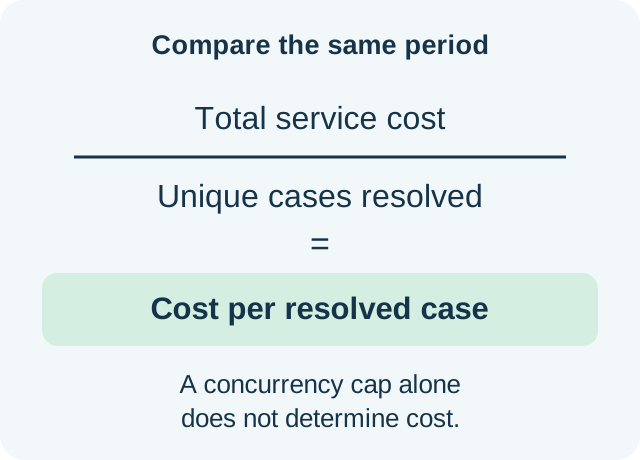
The same principle applies to chat concurrency: the number of open conversations per agent is a capacity setting, not a cost formula. Service time, customer waiting, issue complexity and follow-up all affect how many unique issues get resolved. Research on chat routing and staffing also models these factors together rather than treating concurrent chats as a guaranteed productivity multiplier (Long, Tezcan & Zhang, 2024).
Compare the total service cost over a fixed period against the number of unique issues resolved in that same period:
Cost per resolved issue = total service cost ÷ unique issues resolved.
The denominator matters. Do not count each message, transfer or reopened chat as a new resolved issue. Agree how to treat follow-up contacts before the pilot so both sides measure the same result.
A published price example—and what it does not tell you
For a concrete reference, Callnovo.ai publicly lists several separate offers: dedicated English agents from US$5.80 per hour, shared live support from US$650 per month with 1,500 minutes, pay-per-resolution prices from US$0.79 to US$6.99 by case complexity, and US$0.20 per interaction. These are first-party prices, not a market benchmark or like-for-like rates for a completed chat.
| Published offer | Billing unit | Confirm in your quote |
|---|---|---|
| Dedicated English agent: from US$5.80 | Agent-hour | Required hours, team size, schedule, supervision and included costs |
| Live shared team: from US$650/month with 1,500 minutes | Monthly package and minutes | Whether the package covers chat, what a minute measures and how overages work |
| Pay-per-resolution: US$0.79–6.99 | Successful resolution by complexity | What counts as one resolved issue, treatment of reopened cases and any minimum commitment |
| Interaction: US$0.20 | Interaction | Whether a transfer, repeat contact or multi-channel thread counts again |
The published pages do not settle every project condition. One describes a half-seat minimum for dedicated staffing, while the pay-per-resolution page uses different minimum-commitment language. Ask the sales contact to state in writing whether a minimum applies to your offer, its exact amount, and which page or contract term governs it. The public discount bands also meet at 500 and 2,000 monthly resolutions; confirm the exact rate at those boundaries.
What does 24/7 live chat coverage really mean?
“24/7” may describe a widget, an automated reply, a human queue or a staffed team. Ask which one. If you need out of hours live chat outsourcing, write down the time zone, languages, holidays and the hours when a trained person can take a conversation.
Before launch, confirm:
- Which people are scheduled overnight, on weekends and on holidays?
- What happens when every agent is handling the agreed number of conversations?
- Who receives a complaint or urgent escalation after your own staff leave?
- If no qualified person is available, what message does the customer see and when will someone follow up?
- Does the provider report results by coverage period, so a weak night shift does not disappear inside a monthly average?
Set a clear boundary between staffed support and automation. If a bot captures a request at 2 a.m. and a person replies the next morning, tell customers when to expect that reply and assign an owner for the backlog. Do not label the path live human coverage.
How to choose shared or dedicated outsourced live chat agents
Shared live chat agents can suit a defined queue with straightforward questions, modest volume or a limited coverage gap. Dedicated agents are usually a better fit when the work needs deeper product knowledge, account context or consistent handling across a busy schedule. Neither model is automatically cheaper: compare the commitment, what work is included and what happens at peak times.
If you outsource live chat agents, ask who trains them, who reviews their answers and who covers absences. For shared service, ask how agents learn your policies and whether your conversations wait behind another client’s work. For a dedicated team, ask how replacements are trained and whether supervision is part of the quoted rate.
If your support relies on more than English, specify each language and the hours it must be available. A provider’s total language list does not establish that a trained agent for your queue is available on every shift. Confirm proficiency, backup coverage and any additional charge.
What should happen during setup and handoffs?
Adding a chat widget is only the first step. Agents need the right knowledge, access and instructions to help customers without making promises they cannot keep. Decide whether the provider will use your existing chat or helpdesk platform, and check whether its agents can see the history needed to resolve a request.
If your team already provides the staffing and needs a workspace for channels, routing and conversation history, a software platform may be the better fit. HeroDash’s Multi-channel Workspace is one example; it brings live chat, email, phone, SMS and social messages together. It does not itself provide outsourced agents, so compare software and staffing as separate purchases.
Make a short permissions list before onboarding. For example, agents might be allowed to check an order and open a return request, while refunds above an approved limit stay with your own team. Use the smallest access that lets each role do its assigned work. Confirm who can change those permissions and how access is removed when an agent leaves the project.
For each escalation, agree the receiving team, required context and expected follow-up. A useful handoff carries the customer’s issue, steps already tried, relevant account details and the next action. In a study of human and automated conversations, some language and quality measures changed when conversations moved to a human agent, underscoring why the handoff itself should be tested rather than assumed (Hewitt & Beaver, 2020).
During setup, test at least these routes with your real tools:
- A routine question the agent can answer from approved information.
- A request that needs a permitted action, such as checking an order or booking an appointment.
- A question the agent must escalate because it needs a policy decision or higher access.
- A chat that arrives when the receiving team is offline or already at capacity.
Check that transcripts, outcomes and unresolved cases are visible to your team. Agree who owns a case after a shift ends and how a repeat contact is linked to the original issue.
How can you compare providers in a pilot?
Give each shortlisted provider the same sample week of volume, the same coverage schedule and the same set of common customer questions. Ask for a written scope and reporting example, then test the paths that matter to your business. A sales demo is useful for seeing the interface; it does not show how the service handles an upset customer, a failed integration or an overnight escalation.
| Check | What to request or test |
|---|---|
| Coverage | Shift plan by language, time zone and day; backup for absence and spikes |
| Billing | Unit definitions, minimums, setup fees, overages and a sample invoice using your workload |
| Access | Systems agents use, permitted actions, approval limits and access removal process |
| Response | First human reply and the wait between replies during the conversation |
| Resolution | Unique issues resolved, unresolved chats and same-issue repeat contacts |
| Handoffs | One routine escalation and one after-hours failure path, with context carried forward |
| Quality | Redacted transcripts, review criteria, coaching steps and who handles disputes |
Do not use the first greeting as your only response measure. A quick greeting followed by a long silence may still leave the customer waiting. Track first human response and the time between later replies separately. For later replies, agree the exact start and stop points and report the number of conversations in the sample. If you use a percentile such as P90, define its calculation method; a percentile describes the observed sample, not a service guarantee by itself (NIST).
For repeat contacts, define what counts as the same issue and allow the full follow-up window before calculating the rate. Keep unanswered contacts visible. A pilot report should show both the result and its sample size, split by time band or queue when the sample is large enough to interpret.
When does live chat outsourcing make sense?
Outsourcing can help when customer chats arrive outside your team’s capacity, when you need scheduled coverage without recruiting a full shift yourself, or when a trained provider can take on a clearly defined queue. It can also add work for your team if the provider lacks the knowledge, access or decision authority to resolve the requests customers bring.
Before you commit, compare three things: the work you want handled, the coverage and skills needed to handle it, and the cost of the full service under the proposed billing unit. Start with a limited queue if the scope is still uncertain. Agree what success means, run real handoff and busy-period tests, and expand only when the results match the service you intended to buy.
For questions that move beyond chat into email, phone or technical support, see our guides to email support outsourcing, multilingual call center services and outsourced IT support services. If you are comparing chatbot escalation costs, our guide to AI-to-human escalation billing covers the handoff side.
References
Questions buyers ask
- What does live chat outsourcing cost?
- Providers may charge by agent hour, dedicated seat, interaction, minute, resolution or monthly package. The pricing section gives one published example with different service units; compare scope, minimums and billable definitions before relying on a headline rate.
- How many chats can one outsourced agent handle at once?
- There is no cap that fits every queue. Ask how the provider sets and enforces concurrency, then test it with your easy and difficult conversations. Measure the wait between replies as well as the first human response.
- Can outsourced live chat cover nights and weekends?
- Yes, if people are scheduled for those hours. Confirm the time zone, languages, holiday coverage, backup team and what happens when the queue is full. A chat widget that stays open overnight is not proof that a human is available.
- How do I compare live chat outsourcing providers?
- Give each provider the same sample workload and ask for a written scope, billing definitions, coverage plan, permissions, escalation path and reporting example. Run a limited pilot and review real transcripts, unresolved chats and repeat contacts before expanding.
- Is live chat outsourcing the same as buying chat software?
- No. Software supplies the workspace, routing and reporting tools. Outsourcing supplies people and, depending on the agreement, training or daily management. Confirm whether the provider will work in your current platform and who pays for its licenses and integrations.