

Call Routing Software: Test the Queue, Fallback, and Human Handoff
Test call routing software with a downloadable acceptance sheet. Check IVR vs ACD, rule priority, unavailable agents, human handoff, and verified outcomes.

You wrote the rule: Portuguese tracking questions go to the Portuguese-speaking group. The call matches. Nobody in that group is available. What happens next?
Call routing software directs an inbound call using signals such as the number dialed, menu input, customer records, and business rules. First, identify the intended destination. You also need to know whether that destination can accept the call and what happens when it can’t.
This guide separates those decisions, preserves the useful distinction between IVR and ACD, and gives you a downloadable acceptance record. It also shows how to measure outcomes without treating every call that ends in automation as a solved problem.
Call routing software in one table
Start with the caller’s task. For each path, specify the required skill, the exit when nobody is available, and the information the person answering needs.
| The call | Input used for routing | Intended destination | If nobody is free | Information needed at pickup |
|---|---|---|---|---|
| Package tracking | Language and tracking request | Tracking team in the required language | Qualified backup or a defined callback | Tracking context and what the caller already tried |
| After-hours support | Called number and business hours | Team covering that service window | Recording and owned follow-up | Reason, contact preference, and follow-up commitment |
| Complaint | Caller request or conversation context | Authorized complaint handler | Named escalation path | The complaint and actions already taken |
| Unclear request | Missing or uncertain input | Clarification or human assistance | A tested no-input path | What input was collected and what remains unknown |
These are configuration requirements to test against a product. They aren’t evidence that a particular plan supplies every path automatically.
Separate IVR input from ACD assignment
IVR means interactive voice response. It collects keypad or spoken input and can guide the caller through a task. ACD means automatic call distribution: it assigns work to eligible people or queues. A call queue holds callers while they wait for an eligible person.
| Component | Main decision | Useful evidence |
|---|---|---|
| IVR or conversational menu | What does the caller want, or what input is needed? | Selected option, recognized input, no-input and invalid-input branch |
| ACD | Which eligible destination should receive the call? | Rule match, skills, availability, priority, and assignment result |
| Queue | What happens while the caller waits? | Entry time, wait, timeout, overflow, callback, or abandonment |
The ACD vs IVR distinction doesn’t mean every call needs a menu. A distributor may already have enough information from the dialed number, a CRM record, or another trusted input. Decide whether another question would improve the route before making the caller answer it.
Call forwarding redirects a call to another destination. A routing workflow may also select among eligible destinations using skills, time, or customer context. Check the selection and failure paths rather than assuming forwarding alone supplies them.
“Auto attendant” and “IVR” labels overlap across products. Inspect the behavior you need: transferring to an extension, collecting an order reference, looking up data, or offering a self-service action. The product name alone won’t establish those capabilities.
In Callnovo’s published Latin America logistics case, the menu collects tracking information and language, while the workbench gives the human agent parcel context. That illustrates why collecting information and making it available at pickup need to be tested together.
Test rule priority, language, and capacity
Intelligent call routing may use AI to classify intent, or it may use deterministic rules and existing customer data. Ask which part is inferred and which part is configured. A correct intent label doesn’t guarantee an available, authorized person at the destination.
Separate three kinds of priority: which routing rule is evaluated first, which queued call is served first, and which eligible agent receives it. Changing one may leave the other two unchanged.
Check the rule that actually wins
This small first-match example sends a Portuguese tracking request to the general queue because the broad business-hours rule wins first:
RULES = [
    (lambda c: c["open"], "general_queue"),
    (lambda c: c["lang"] == "pt" and c["intent"] == "tracking", "pt_tracking"),
]

def route(call):
    for matches, destination in RULES:
        if matches(call):
            return destination
    return "after_hours_team"

print(route({"open": True, "lang": "pt", "intent": "tracking"}))
# general_queue
This is a teaching example for a first-match engine. Confirm your platform’s evaluation semantics. Moving the specific rule earlier fixes this example, but also check whether an after-hours or safety rule is intended to take precedence. “Specific first” is not a substitute for defining those requirements.
For a concrete product example, Twilio TaskRouter’s workflow documentation describes first-match filters and a default filter for tasks that match none of them. That is Twilio’s documented behavior; it doesn’t establish how every phone platform works.
Check whether the destination can accept the work
Skills-based routing selects from agents with the required skills. Inspect each eligible agent’s current state, channel eligibility, and remaining capacity. Test what happens when two assignments compete for the last available slot, and whether a failed assignment releases it.
HeroDash’s assignment concepts also apply to tickets, chats, messages, and missed-call callbacks. Keep that scope separate from live voice behavior: a ticket assignment rule is not proof of how the carrier, voice queue, or transfer handles a live call.
Within an eligible pool, products may offer several assignment strategies:
| Strategy | Selection rule to inspect | Tradeoff |
|---|---|---|
| Round robin | Rotate among eligible members | Doesn’t necessarily optimize for workload or expertise |
| Priority | Try a preferred tier before a backup | Backup may receive little work until the preferred tier is unavailable |
| Weighted | Allocate according to configured proportions | Check whether weights apply to people, groups, or both |
| Random | Select an eligible member at random | Small samples may be uneven |
| Manual claim | An eligible person accepts the work | Requires someone to notice and claim it |
For sticky assignment, ask what links a returning contact to the previous agent and what happens when that person is unavailable. The same caller ID is a routing hint, not proof that the caller has the same unresolved issue or is authorized to act on the account.
Prove the no-agent fallback and human handoff
Call queue software needs an explicit path for a matched destination with no available agent. Also test a destination that rings but doesn’t answer, a rejected transfer, and a system failure. Those conditions may generate different events.
| Exit | Caller experience to verify | Ownership to record |
|---|---|---|
| Continue waiting | A defined wait policy and usable next option | Queue owner and escalation condition |
| Overflow | A destination with the required language and authority | Backup team and accepted transfer |
| Callback | Confirmation of the request and applicable commitment | Callback owner, due time, and completion evidence |
| After-hours handling | Accurate staffed hours and next step | Follow-up team and review schedule |
A callback ticket being created doesn’t prove the callback happened. Keep both events. Similarly, a routing log saying “transfer requested” isn’t evidence that the receiving person answered.
RFC 5589, section 6.3, documents SIP transfer failures, including a busy target and a target that doesn’t answer, with flows that resume the original session. The protocol example is a useful test reference; verify the actual behavior of the system you’re buying.
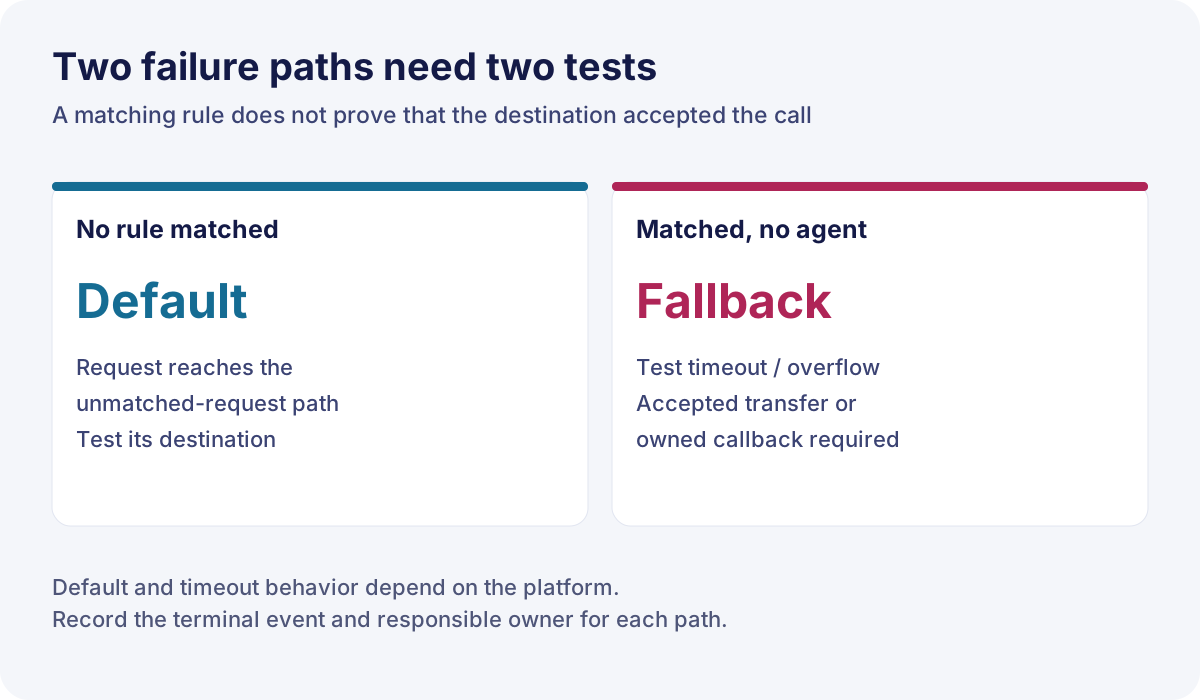
A default rule is not a universal timeout handler
In the Twilio workflow documented above, the default filter handles tasks that didn’t match a filter. It is not a subsequent filter for timeout handling. Depending on the remaining targets and matching filters, a task can time out and be canceled.
Test the two cases separately: no rule matched, and a rule matched but delivery failed. Record the actual terminal event in each case. An apparently complete default configuration can still leave the second path unfinished.
Send usable context with the handoff
An AI phone agent should have explicit handoff triggers, including a request for a person, an unresolved repeated attempt, missing authority, or a situation requiring human judgment. Test the trigger and the receiving path together during staffed and unstaffed hours.
| Handoff field | What the receiving person needs |
|---|---|
| Task and context | What the caller wants and what has already happened |
| Relevant reference | The order, tracking, or case reference collected for this task |
| Actions attempted | Result, failure, or unresolved state for each consequential action |
| Verification scope | What was verified, for which task, and when it expires |
| Next owner | Who can continue and what commitment has been made |
The verification fields are acceptance requirements to discuss with the vendor, not a claim that every platform already transports them. A caller recognized by phone number may still need verification for a sensitive action. If verification is expired or covers a different task, the receiving person needs to know that before proceeding.
Measure resolution with mutually exclusive outcomes
Containment rate describes calls that stay within automation under your chosen definition. Call deflection describes movement away from a live channel. Neither proves that the customer’s task was completed.
Subtracting abandoned calls and recontacts from contained calls can also produce a counting error. In a synthetic group of 100 contained calls, suppose 20 abandoned, 30 later recontacted, and ten did both. Calculating 100 − 20 − 30 gives 50. Removing the union correctly gives 100 − (20 + 30 − 10) = 60. Those 60 are still only calls without either observed flag; they aren’t verified resolutions.
Build the outcome groups around an index issue
Use an index contact linked to an issue ID, a documented completion event, and a chosen follow-up window. Match recontacts to the same issue across the channels you can reliably observe. Keep unlinked contacts as uncertain rather than treating all later calls from the same number as failures.
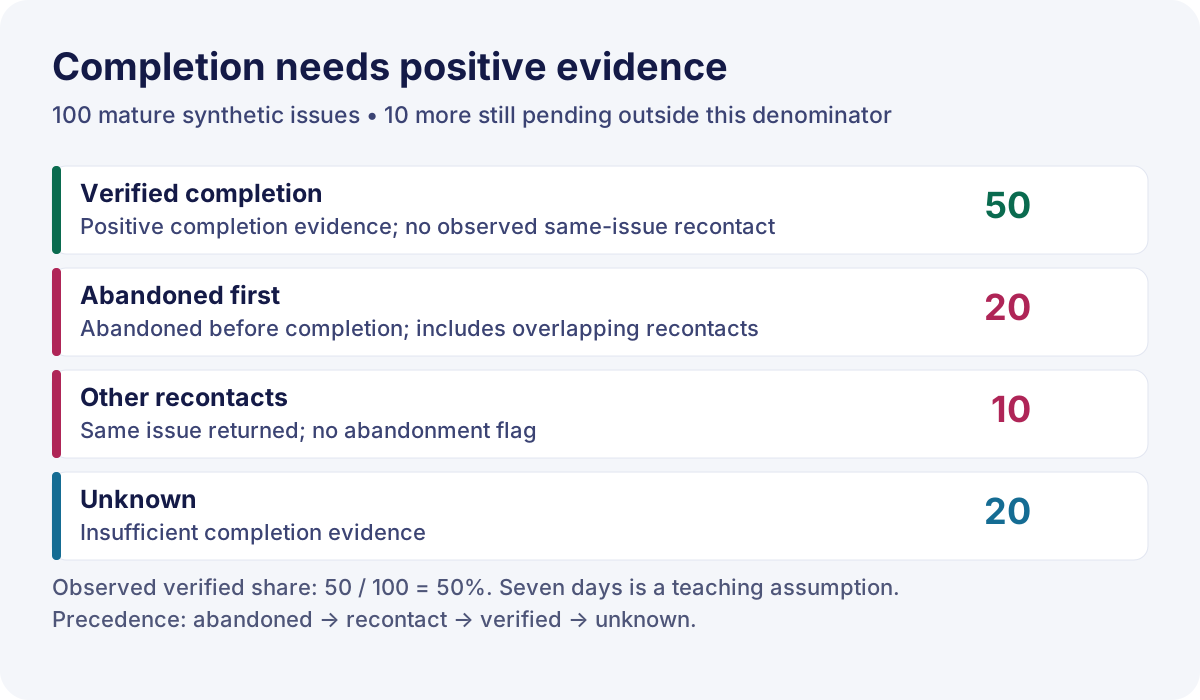
A separate resolution outcome example contains 110 synthetic index issues. In this teaching example, 100 have completed a seven-day observation window; ten are still pending and remain outside the mature denominator.
Classify the mature issues in this order: abandonment before completion; otherwise same-issue recontact; otherwise verified completion; otherwise unknown. The precedence makes the categories mutually exclusive, including when an abandoned caller later recontacts.
| Mature outcome | Issues | Interpretation |
|---|---|---|
| Verified completion with no observed same-issue recontact | 50 | Positive completion evidence exists |
| Abandoned before completion | 20 | May also have recontacted; counted here once |
| Same-issue recontact, without the abandonment flag | 10 | Needs review of why the customer returned |
| Unknown | 20 | Insufficient completion evidence |
| Mature total | 100 | Pending issues are reported separately |
The observed verified-completion share is 50 ÷ 100 = 50%. Report it with the window and channel coverage. Seven days is an illustrative choice, not a universal resolution standard. Longer-running tasks need a follow-up period that fits their actual lifecycle.
Keep first-contact resolution and customer satisfaction beside the routing measures. A successful connection establishes that someone answered; a completed refund, replacement, or lookup establishes a different outcome. Choose the evidence that fits the task instead of calling every quiet conversation resolved.
Routing setups compared, and where Callnovo.ai fits
Compare systems against the routes your callers need. A small team with a simple directory may need fewer features than a multilingual support operation with order lookups and human escalation.
| Setup | Suitable starting task | Verify before buying |
|---|---|---|
| Business phone system with auto attendant | Reach a person or extension | No-answer behavior and staffed hours |
| Cloud IVR plus ACD | Collect context and reach a qualified queue | Skills, capacity, overflow, and reporting definitions |
| AI phone agent with human backup | Handle supported tasks conversationally | Action permissions, completion evidence, and human handoff |
| Outsourced human team on a support platform | Supply coverage and skills as well as routing | Actual staffed languages, hours, authority, and escalation ownership |
HeroDash supplies the platform side of Callnovo.ai’s offering, while multilingual support teams provide people for the agreed coverage. Confirm live voice behavior separately from ticket and message assignment during the demonstration. The test sheet below works for either layer when the expected events are named correctly.
Use the current pricing page and a scoped quote to compare seats, carrier usage, AI usage, minimum charges, and staffing. A free plan or trial is only useful if it lets you test the required route and its failure paths. Confirm what changes when the trial ends.
If you receive only a handful of calls, assess whether a menu adds useful information before introducing it. If your task is sales-lead scoring or advertising attribution, include those requirements explicitly; they aren’t established by a support-routing demonstration.
Use a repeatable vendor acceptance record
Download the routing acceptance sheet. It contains seven proposed test cases with initial conditions and expected outcomes. Actual-result and evidence fields are deliberately blank so your team can record what the system does.
The cases cover no input, competing rules, no eligible agent, transfer failure, expired verification, an unsuccessful tool action, and a callback that reaches its due time. For each run, record the route version, test time, event IDs, caller experience, final state, and responsible owner.
For AI paths, NIST’s AI Risk Management Framework calls for evaluation under conditions similar to deployment, documented measures, and assigned responsibility for overriding or disengaging systems that don’t behave as intended. Those voluntary framework principles support this test design; they don’t certify a vendor’s implementation.
Use this 11-point implementation checklist with the sheet:
- Group menu choices around caller tasks.
- Test whether another menu layer is necessary.
- Review common requests before a known peak.
- Configure no-input and invalid-input paths.
- Define the unmatched-request destination.
- Test overlapping rule conditions and their intended precedence.
- Define the exit when the matched destination is unavailable.
- Confirm the configured AI phone agent answers the intended number.
- Test each human-handoff trigger and its context.
- Run the paths again after changing the configuration.
- Have the responsible team verify applicable recording and privacy requirements for the deployment.
References
- IETF / RFC Editor. 2009. Session Initiation Protocol (SIP) Call Control — Transfer, section 6.3.
- NIST. 2023 framework. AI Risk Management Framework 1.0, AI RMF Core.
Three calls before you change the live route
- What happens when you provide no input? If the call drops or loops unexpectedly, repair the no-input path and repeat the test.
- What happens when the correct group has nobody available? If there is no accepted fallback or owned follow-up, the matched rule hasn’t completed delivery.
- What can the receiving person see after a transfer? If task context or verification scope is missing, define how it will be recovered before the person acts.
Choose call routing software against those observed outcomes. Keep the accepted route version and test evidence so the next configuration change can be checked against the same requirements.