How to outsource to a Philippines call center
Outsource to a Philippines call center with a clear plan for pricing, US coverage hours, provider trials and the decisions your own team keeps.

If you plan to outsource to a Philippines call center, start with the work your customers need done and the hours when they need help. A provider should be able to show how its team will handle your calls, use your systems and pass exceptions to someone who can decide. A low hourly quote answers only one part of that decision.
This guide is for businesses buying support. It covers what to put in a quote request, how US working hours translate into a Manila shift, and how to test a provider before moving a whole queue. You can use the same brief with every shortlisted company, which makes the proposals much easier to compare.
Is a Philippines call center right for your workload?
A Philippine team is worth considering for an English-language queue when you need a dedicated group to learn your products and follow your service procedures. The useful test is a conversation about your actual customer problem. Ask how the agent finds the answer, explains it and records the next action. Nationality or a familiar accent cannot establish those skills for an individual team.
Start with one recent week of contacts. Separate calls from email and chat, then group them by the job the customer wanted completed. An order-status question, a damaged-product report and a request for a refund may all come through the same number, but they require different knowledge and authority.
| Workload | What to ask a provider to demonstrate |
|---|---|
| Order and delivery questions | Finding the correct order, explaining the available tracking information and escalating a stalled delivery |
| Product support | Using approved troubleshooting steps and recognizing when a technical specialist is needed |
| Appointment requests | Checking the service area and approved availability, then recording a confirmed booking or callback request |
| Returns and billing questions | Applying your policy while reserving exceptions for the person with approval authority |
| Email or ticket follow-up | Keeping the conversation history, owner and next action clear between shifts |
Keep work with your own team when it requires authority you cannot delegate or information you cannot make available. You can still outsource the initial conversation and preparation of the case. For example, an agent might gather a warranty claim while your service manager decides whether to approve a replacement.
If you also need Spanish, French or another language, specify the requirement separately. Do not assume that an English-speaking Philippine team provides every other language from the same location. A provider may propose another delivery team, a different schedule or an approved translation workflow. Ask which arrangement your quote includes.
What should a Philippines outsourcing quote include?
Ask for a quote against the same workload and service window. Include contact volumes by channel, busy periods, average handling time if you have it, and the work agents must complete after a conversation. Tell the provider whether customers expect an immediate answer or whether a later response is acceptable.
The unit matters. A full-time equivalent, often shortened to FTE, describes staffing capacity. A productive-hour rate may count only defined working time. A shared answering package can charge a monthly amount for included minutes. These arrangements do not buy the same thing, even when you can convert each headline into an hourly figure.
| Quote item | Question that makes it comparable |
|---|---|
| Staffing | Is this a dedicated agent, a shared arrangement or a pool with a stated service commitment? |
| Hours | Which days, holidays and time zone are covered? Who takes over when a shift ends? |
| Training and supervision | What initial training, coaching and management time is included? |
| Tools | Are the CRM, ticketing system, phone number and communications charges included or separate? |
| Coverage gaps | How are absence, peak demand and unexpected outages handled? |
| Exceptions | Does the agent resolve the case, collect information or wait for your approval? |
| Billing | What is the minimum, what triggers additional charges and how can scope change? |
Callnovo’s published starting prices include dedicated English support from US$5.80 per hour per agent and shared English support from US$650 per month with 1,500 included minutes. These are Callnovo package references, not a Philippine market average or a quote for every Philippine program. The shared phone package has a stated weekday service window; overnight and weekend coverage need a separately agreed scope. See the current pricing and package conditions.
Standard Callnovo projects use dedicated staffing. A shared arrangement can be assessed for lower-volume, backup or overflow needs. If your phone rings only occasionally, ask which model fits that pattern before assuming a dedicated full-time team is necessary.
AI voice is another cost category. The published English voice-bot usage rate is US$0.15 per active AI minute, with a US$200 monthly minimum for that bot and carrier charges separate. A short call’s usage calculation does not remove the monthly minimum. Keep AI, software and human-service costs separate in the proposal so you can see what each part contributes.
For your own comparison, calculate the total monthly cost of the agreed service, then divide it by the contacts it actually handles. Label an estimate as an estimate. Include your internal approval time if it remains substantial; otherwise you may appear to save money by moving work back to your managers without counting it.
How do US hours translate into a Manila shift?
Write the customer’s time zone and the delivery team’s time zone into the schedule. A Manila daytime shift can cover overnight hours in the United States. Covering a US daytime queue generally means a Philippine evening or night shift. The difference changes when the US location changes its clocks.
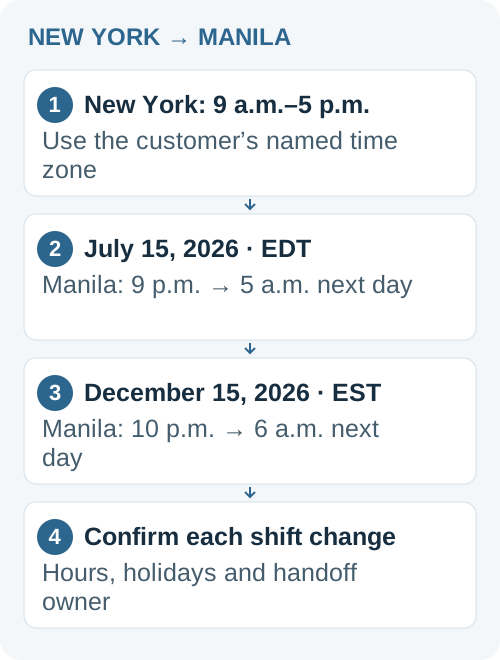
For a New York business open from 9 a.m. to 5 p.m., these dated examples show the corresponding Manila hours:
| New York date and hours | Manila date and hours |
|---|---|
| July 15, 2026, 9 a.m. to 5 p.m. EDT | July 15 at 9 p.m. to July 16 at 5 a.m. |
| December 15, 2026, 9 a.m. to 5 p.m. EST | December 15 at 10 p.m. to December 16 at 6 a.m. |
These are time conversions, not proposed staffing commitments. NIST explains the US daylight-saving rules, including the spring and autumn clock changes. Specify the US city when checking a schedule; New York’s example should not be copied to every US location. The Philippines uses Philippine Standard Time, identified as PhST by PAGASA.
Ask who checks the schedule before a clock change and how the change affects shift overlap. Also list both countries’ relevant holiday dates. A contract saying “US business hours” leaves too much room for disagreement if it does not identify the actual days and time zone.
A 24/7 proposal should show coverage for all shifts, breaks and handoffs. Ask who receives an unresolved issue at the end of the night and what happens if that person is unavailable. A shared case record and a named receiving team are more useful than a promise that a message will be passed along.
How do you shortlist and test a provider?
Use provider lists to find candidates, then assess the team that would work on your account. A company’s position in a “top ten” list does not tell you its available staffing, relevant experience or ability to work inside your systems. Ask each candidate to respond to the same short brief and demonstrate the same tasks.
Choose a small set of representative conversations. Include a normal question, a policy exception and a situation where the needed information is missing. For each test, decide in advance what a correct response looks like. This keeps the review focused on service quality instead of whether the demonstration feels polished.
| Test | What you should be able to inspect afterwards |
|---|---|
| Customer asks about a delayed order | Correct order found, available status explained, no invented delivery promise |
| Customer requests an exception | Request recorded and sent to an authorized decision-maker |
| Agent cannot access the required system | Safe fallback used, information retained and a follow-up owner assigned |
| Case crosses a shift boundary | Next agent can see the history, commitment and pending action |
Use fictitious or properly anonymized information for early demonstrations. The FTC’s Start with Security guide advises minimizing data collection, controlling access and avoiding unnecessary use of real personal information in training or development. Apply that principle while testing: agents need enough detail to demonstrate the workflow, not your entire live customer database.
Review the actual work with the provider. If a customer had to repeat information, find out why. Was it missing from the record, difficult to find or outside the next agent’s access? The answer determines whether you need a process change, a tool change or more training.
Set a review point before expanding the queue. Check the accuracy of answers, completeness of follow-up and the amount of work your own team still has to redo. Agree how problems will be corrected and retested. Use the pilot to confirm that the team can handle the agreed work before expanding the queue.
What will Callnovo handle, and what stays with your team?
Callnovo provides multilingual customer support with delivery operations that include the Philippines. You can discuss phone support, email, chat and follow-up work as part of the same program, while confirming which team and system will own each task. Our Philippines customer-service page explains that service context in more detail.
Your team supplies the product information, service policy and approval limits. Callnovo can work within the agreed process and pass exceptions to the owner you name. Before launch, confirm which records agents can read or update, how customer history follows the conversation and how changes to your policies reach the team.
Staffing can be ready in as little as five days under the standard setup. The full schedule depends on training, access and pilot requirements; connecting to your own CRM, ticketing or dispatch systems can add time. Plan the handover around the tasks that must work on day one, and test those tasks before sending live traffic.
To request a scoped proposal, send the channels, languages, service hours and a representative volume breakdown. Include a few anonymized examples of difficult contacts and the decisions you want to retain. That gives both teams a practical starting point for staffing, pricing and a pilot you can evaluate.