

Outbound Call Center Services for Sales and Customer Follow-Up
Compare outbound call center services by task, handover, caller-identity handling, pricing scope and evidence of completed work before you expand a campaign.

Outbound call center services give you a team to call customers or prospects for a specific reason. You might need someone to confirm appointments, follow up on a service problem, or collect feedback. Before asking for a quote, decide what you want that team to finish.
Getting someone on the phone, booking an appointment, and having that person show up are different results. Each needs a different record. That choice shapes the script, staffing, price, and report you’ll receive.
You also need to decide what stays with your own team. A calling team can take down a request to make an exception. Someone with permission to approve it still has to make the decision.
What do outbound call center services include?
An inbound team answers the calls that come to you; an outbound team calls customers or prospects on your behalf, for a reason you set. A managed service provides people and a plan for running the work. Calling software provides the tools. You can also run an internal team, keeping staffing, supervision, and follow-up inside your company.
The work goes beyond sales. AnswerNet lists appointment setting, research, data work, and telesales among its outbound services. Vonage also describes customer follow-ups and feedback collection.[1][2] To turn those categories into a useful work order, spell out what the team will do:
| Your situation | What the calling team does | What you still decide |
|---|---|---|
| Customers need to confirm or change an appointment | Call, explain approved options, record the customer’s choice | Available slots and who can approve an exception |
| Existing customers have unresolved questions | Follow up, write down the issue, arrange the next action | Refunds, remedies, or policy exceptions |
| A sales team needs qualified conversations | Contact approved prospects and check the agreed qualification criteria | What qualifies and who takes over afterward |
| A product or market research team needs feedback | Ask approved questions and record responses | Survey design and what to do with the answers |
An outbound call center may cover several of these tasks. Ask which are included in the proposal and who supervises each one. Supplying a dialer, the tool used to place calls, doesn’t necessarily include managing the campaign.
For the wider division of work, see the customer service outsourcing framework. Here, we’ll focus on what to hand over and how to check what gets done.
Match the workflow to the reason for calling
Sales outreach, appointment reminder calls, and service follow-up need different opening questions. They also need different rules for when the job is done. Someone expecting an appointment confirmation already knows your business. A prospect hearing from you for the first time doesn’t.
For reminders, decide what a human agent can change. Can the representative confirm attendance, move a booking, or only pass on a request? If a manager must approve rescheduling, the record should say “change requested.” It shouldn’t say the appointment has moved.
Imagine a customer who gets an automated reminder but still wants to ask about opening hours. The representative checks the approved schedule, answers the question, and asks whether the appointment still works. If the customer brings up an unresolved complaint, someone needs to own that follow-up too. Confirming the appointment doesn’t close the complaint.
For sales calls, agree on qualification criteria: the checks a prospect must meet before your sales team takes over. “Interested” doesn’t tell a salesperson much. Do they need to know the person’s buying role, the problem they want to solve, or whether they’ve agreed to another conversation? Choose the checks your team actually needs. Allow “unknown” when the caller couldn’t get an answer.
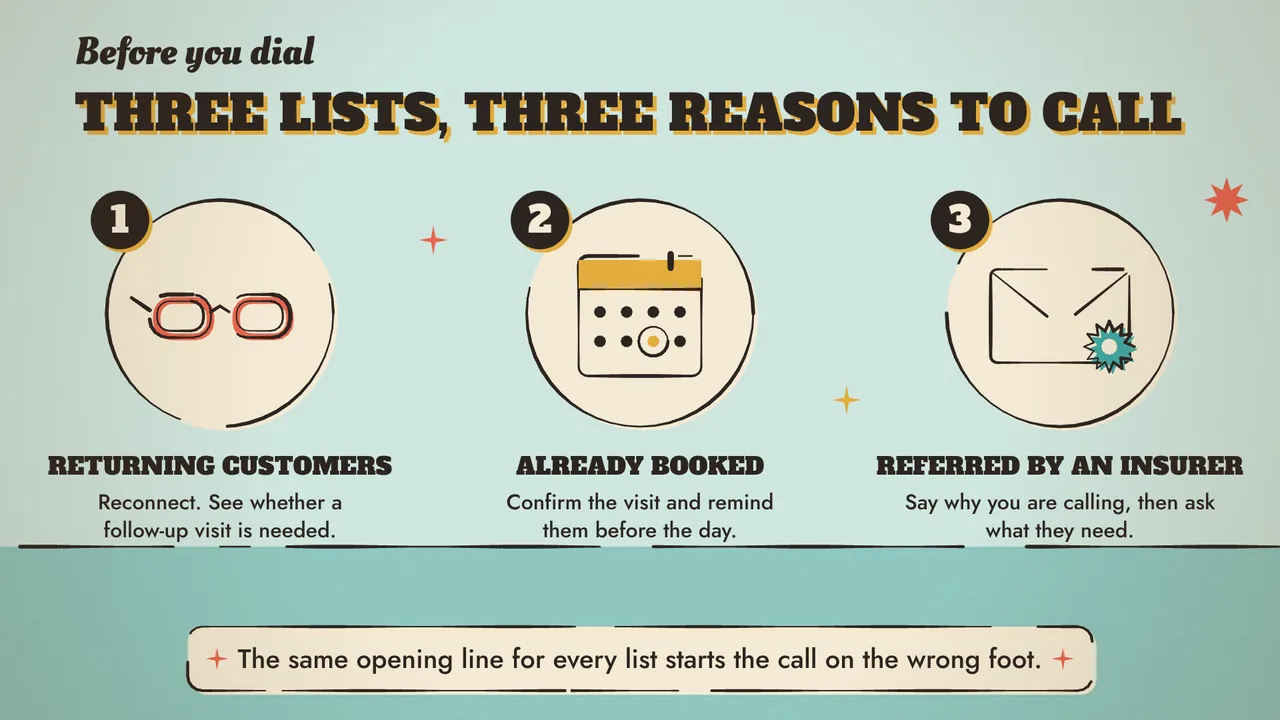
The source of the call list matters as much as the purpose. On a US eyewear and optometry program we support, the store’s system sends automatic reminders, and our agents call from lists the store provides. One list holds returning customers who are due for another visit; that call reconnects and checks whether a follow-up visit is needed. Another holds customers who already have an appointment; that call confirms the visit and reminds them before the day. A third holds customers referred by an insurer; the agent first says why they are calling, then asks what the person needs. A single “time for your check-up” opening for all three lists gets the first sentence wrong.
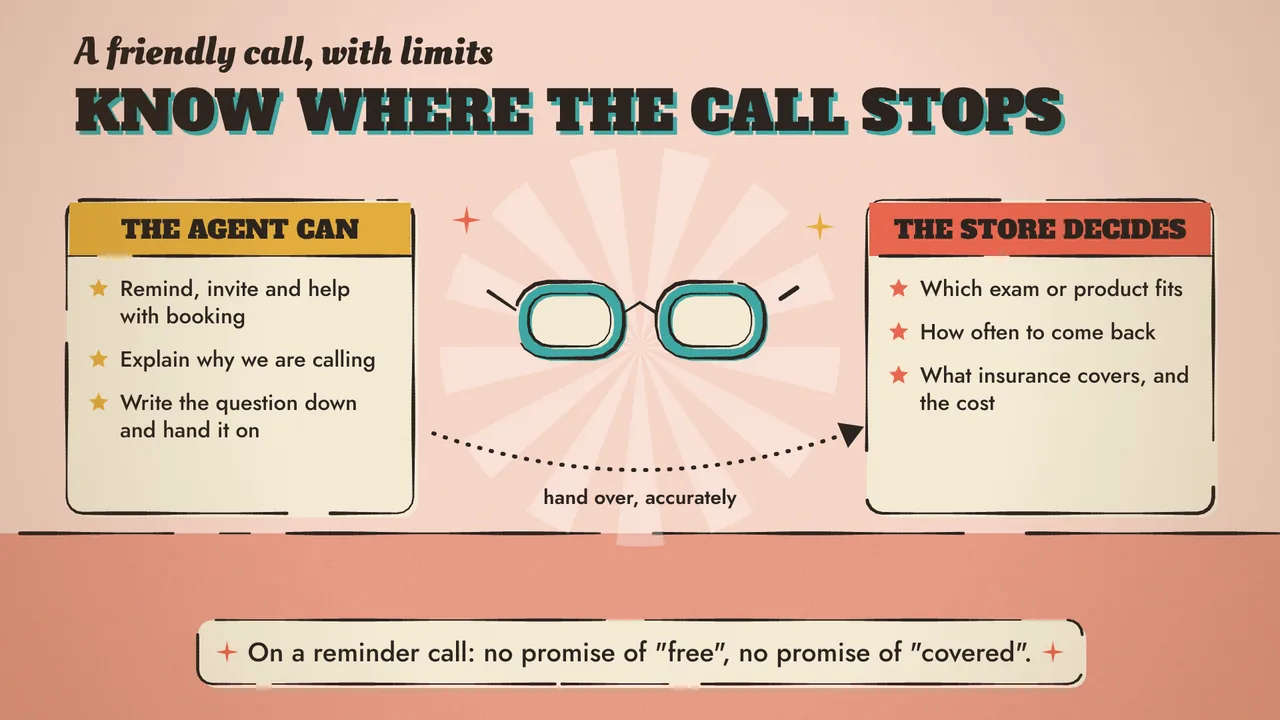
Agents on that program know which services the store offers, but they don’t decide which exam or product suits someone, or how often a person should come back. They also don’t promise that a service is free or that insurance will cover it. Those questions are written down and handed to the store.
A customer retention call center needs clear instructions as well. Someone asking to cancel might need a billing explanation, a service change, or simply no further contact. Don’t give all three the same script. Set out which offers the representative can make and when the account owner must take over.
Keep regulated tasks separate. Medical advice, insurance determinations, and financial recommendations need their own scope review. They aren’t part of a routine scheduling or feedback task.
Give the calling team what they need before the first call
Prepare the approved contact list, instructions, and person to ask when something falls outside the rules. A handover should help a representative answer the customer’s question without inventing policy or repeatedly asking a supervisor.
A short campaign brief can cover the essentials:
| Handover field | What to put in it |
|---|---|
| Purpose | Why you’re calling and what the customer should be able to do next |
| Contact scope | Where the list came from, what it may be used for, who to exclude, and who approved it |
| Schedule | Approved calling windows and the customer’s time zone |
| Script | Current version, approved answers, and when escalation to a supervisor is needed |
| Caller identity | The exact company name the representative uses, what they may say when asked who they are, and the official number or website a customer can use to check |
| Authority | What the representative may do and what your team must decide |
| Follow-up | Callback rules, due dates, and who takes unresolved work |
| Records | Fields to fill in and the system that holds the final result |
| Stop conditions | How refusals, wrong numbers, and disputed contact details leave the active list |
For a US campaign spanning Eastern and Pacific time, “call tomorrow morning” isn’t specific enough. Save the date and the customer’s time zone with the callback. Use the approved local-time window, wherever the calling team happens to work.
Choose a system of record: the place everyone checks for the final answer. If appointments live in your booking application, a note in the provider’s spreadsheet doesn’t confirm a change. Decide who updates the booking application and how both teams check that their records match. Test an integration before describing what it can do.
Run the handover in order:
- Review the contact list and approve the instructions.
- Run a controlled test and inspect the records it produces.
- Send any failed checks back to the person responsible.
- Release the agreed batch of contacts once those checks are resolved.
Have your legal or compliance team approve contact eligibility, suppression handling, recording practices, and calling restrictions. Contact eligibility means who may be called for this purpose. Suppression means keeping people who shouldn’t be contacted off the active calling list. With outbound calling services, both teams still need to know who handles these checks and where to find the approved rules.
Pause the script when the customer questions the call
A follow-up call often reaches someone who wasn’t expecting it. The FTC warns consumers that scammers can make any name or number show up on caller ID (Federal Trade Commission, 2023). It also tells them to contact a company through a phone number or website they know is real, not one the caller provides (Federal Trade Commission, 2025). A customer who stops to ask who is calling is doing what they’ve been told to do. The script has to allow for that.
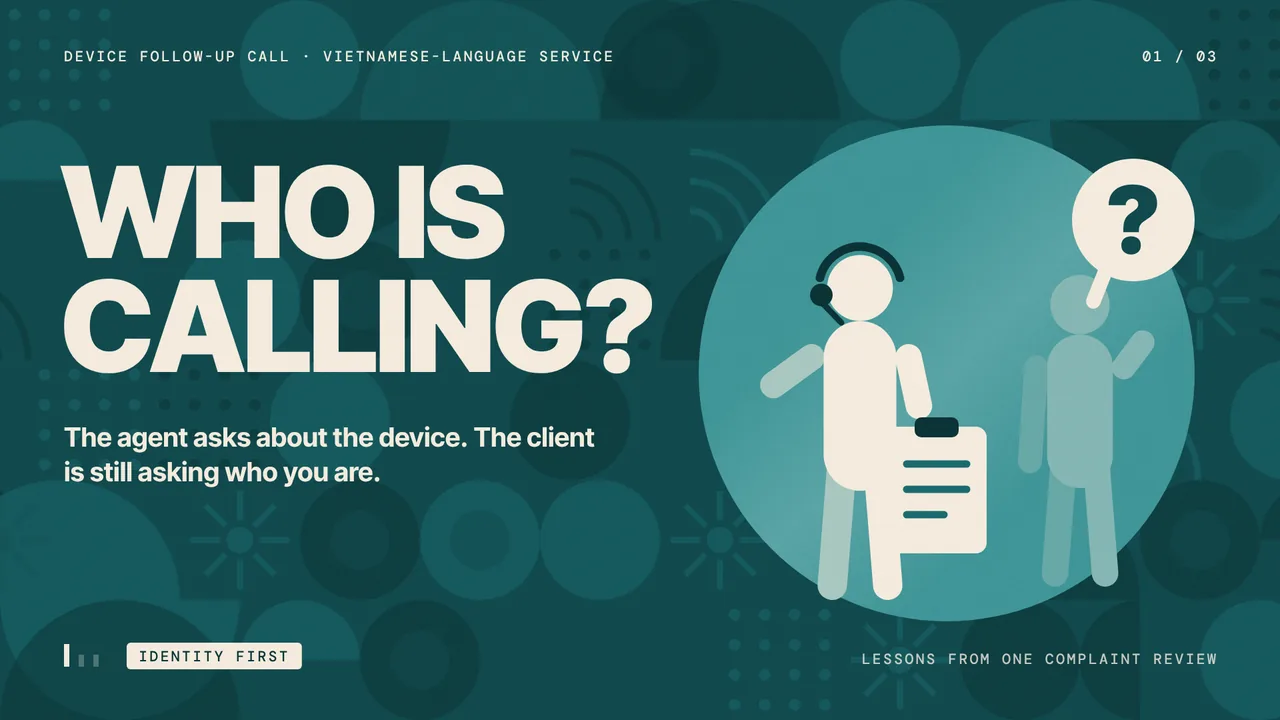
We saw what happens when it doesn’t on a Vietnamese-language follow-up program for a medical device maker. The task was a short equipment survey. The agent greeted the customer, introduced the call and explained its purpose, then asked whether the device was working normally. The person who answered kept asking which organization was calling, why they had been contacted, and whether the caller knew who actually used the device. The agent didn’t have enough information to answer and kept trying to finish the survey. The call ended in a complaint.
The review asked two kinds of questions:
- Facts. What the agent said and didn’t say, and where the complaint matched the record. The service-center name the agent used differed from the wording the local team recommended. The complaint also mentioned a request for a serial number; the transcript showed the device model, not a request for the serial number.
- Experience. Why the customer still felt confused and unheard, and where the team had failed to explain. Correcting the serial-number detail didn’t answer that question.
Because the call was in Vietnamese, wording and tone were checked by a team member who speaks the language, against the original recording rather than a translated transcript alone.
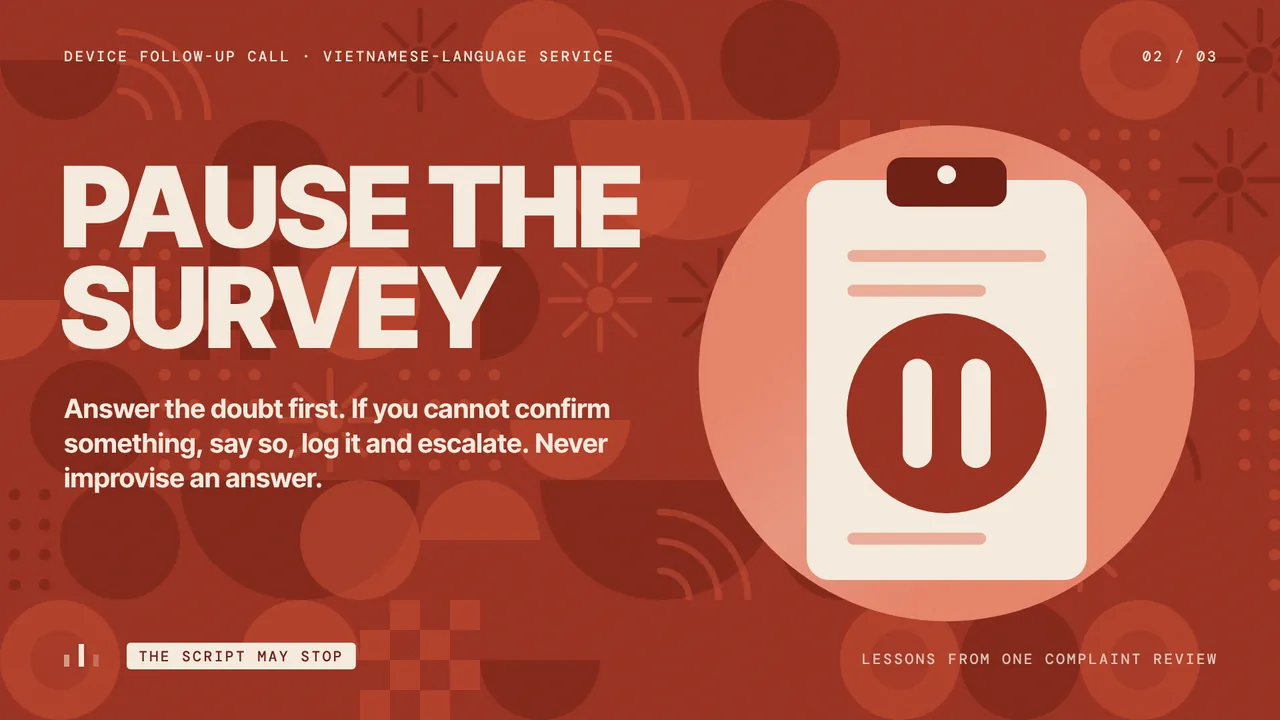
The lesson for the script was plain: once the customer’s question changes, the survey stops until that question is answered.
The changes that followed apply to everyone on the program:
- The organization name, the reason for the call, and what agents may say when asked follow-up questions are agreed with the company that commissions the calls. Agents don’t fill a gap with an answer that sounds plausible. They say the detail needs checking, record the question, and pass it to the named contact.
- Training includes calls that leave the script: a customer questioning who is calling, saying the wrong person was contacted, refusing to continue, or asking something the agent can’t confirm. The practice is about when to pause, how to respond, and how to record and escalate.
- Full-time and part-time agents who make the same calls learn the same rules, not only the agent involved.
- Quality reviews of part-time and low-volume outbound work check whether the customer’s doubts were answered, not only whether the survey was completed.
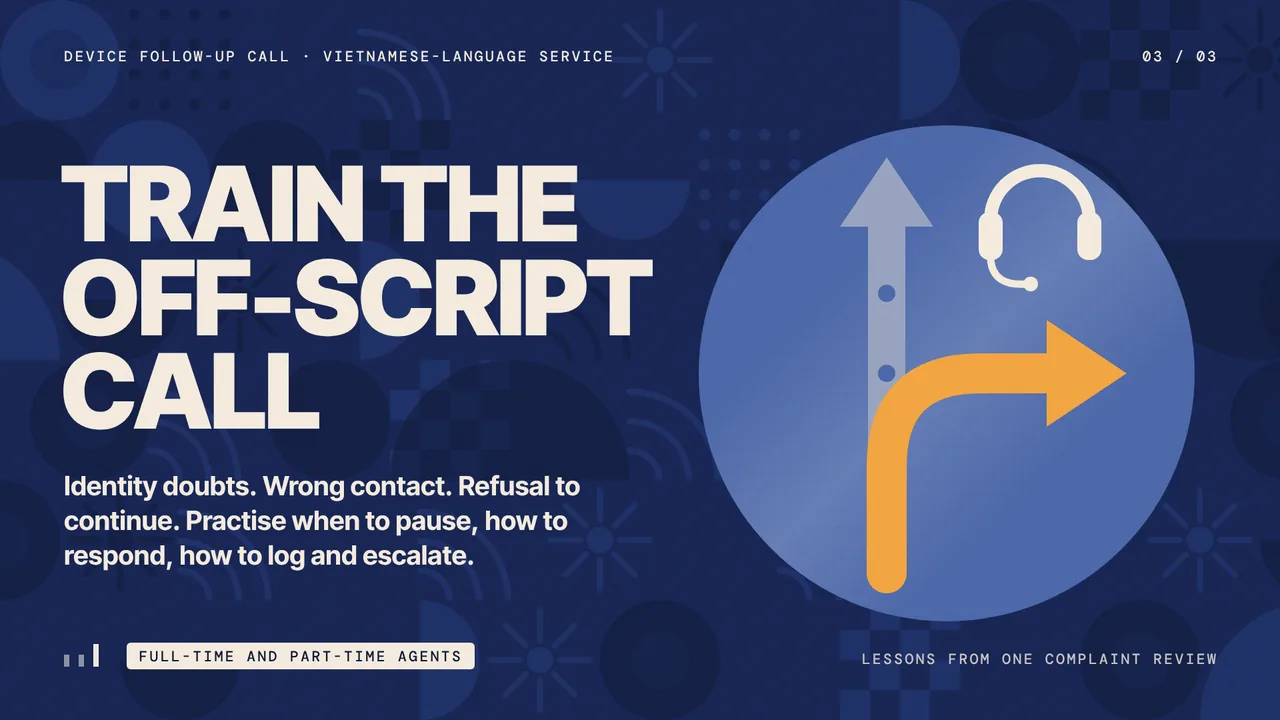
For a healthcare outbound call center, or any follow-up that mentions a device, an account or a past visit, give agents the approved identity wording and the official verification route before the first call. When a customer is still unsure, offering the company’s published number and noting that the survey is paused ends the call better than one more survey question.
Agree on what counts as a completed result
Keep each result separate and save the record that supports it. A connected call isn’t a booking, and a booking doesn’t prove attendance. If a report says appointments were booked, the reviewer should be able to find those appointments.
Use this proposed reporting template and adapt the labels to your campaign. These are suggested fields, not results from a customer account.
| Status | What it means | Record to keep |
|---|---|---|
| Attempted | A call was placed | Call identifier and timestamp |
| Connected | A conversation happened under your agreed definition | Call record and disposition |
| Callback requested | The person asked to be contacted again | Requested date, time zone, and next owner |
| Qualified | The agreed checks were completed and passed | Answers against each criterion |
| Booked | The booking system confirmed an appointment | Booking identifier and scheduled time |
| Attended | The business recorded attendance | Attendance record from the receiving team |
| Resolved | The agreed service task was completed | Resolution record that meets the agreed criteria |
| Paused for verification | The customer questioned who was calling and the call stopped | The question asked, the verification route offered, and the next owner |
| Further contact declined | The person asked for contact to stop | Suppression action and its confirmation |
The term call disposition means the recorded result of one call. “Callback requested” is a disposition. It ends that call, but the customer task stays open until someone makes the callback and completes the work.
Your outbound customer service report should keep calls, people, and appointments separate too. One person can receive several attempts. One appointment can move more than once.
Suppose a customer books Tuesday and later moves the appointment to Thursday. Keep the original booking ID, update its scheduled time, and retain the change history. Counting both dates as separate bookings makes the result look better than it is.
Your ledger, or running list of results, could use these columns:
contact_id, task_id, call_id, script_version, call_disposition,
outcome_evidence, next_action, owner, due_at_with_timezone
Use identifiers instead of unnecessary personal details in shared reports. Follow the approved data-handling policy for who can open the customer record behind each identifier.
If you report a rate, say what you’re dividing by what. The numerator is the result you’re counting; the denominator is the group you’re comparing it with. “Booked appointments divided by unique contacted customers” measures something different from “bookings divided by all call attempts.” Both can help, provided you label them separately and use the same reporting period.
You may get attendance updates after the calling report is finished. Give someone the job of matching those updates to the bookings. Until then, keep booked and attended in separate columns, each with its own update date.
For a broader reporting setup, the call center analytics guide explains how conversation data helps you decide what to change.
Check what’s included in each quote
Compare outbound call services by the work included, then compare the price. One provider’s calling rate might leave out preparation or record reconciliation, the work of checking that records match. Another proposal might include both.
Send every provider the same scope sheet. Keep quoted amounts in their original currency. Separate ongoing charges from setup costs and change requests.
| Cost item | What to ask |
|---|---|
| Training | Who prepares materials, runs practice calls, and decides the team is ready? |
| List preparation | Who removes duplicates, checks exclusions, and fills in missing details? |
| Calling time | Which time is billable, including unsuccessful attempts? |
| Follow-up | Are callbacks, notes, and booking updates included? |
| Supervision | Who handles exceptions and fixes inconsistent call dispositions? |
| Systems | Which access, telephony, or integration costs are extra? |
| Changes and exit | What happens when scripts change or the campaign ends? |
If one proposal charges per appointment and another by the hour, first agree on what “appointment” means. Do cancellations affect billing? What about duplicates or a booking that gets moved? Put those rules in the commercial agreement so you can compare the proposals fairly.
Count your team’s work as well. Someone still needs to approve scripts, answer escalations, and accept the results. If a manager must review every disputed record, that time belongs in your assessment.
Try a small pilot before expanding
A pilot is a limited trial of the work. Use it to see whether the team follows instructions, records results, and sends exceptions to the right person. Agree on the size and acceptance rules before starting. A high call total alone isn’t a reason to expand.
Rehearse an ordinary completion, a callback, a wrong number, a customer who questions who is calling, and a request that needs approval. Use authorized test contacts. If you then run a live pilot, follow the approved contact and data-handling rules.
Let the people who use the results check them. The appointment owner reviews bookings. Sales checks whether qualified handoffs meet its criteria. The service lead checks that unresolved issues reached someone who can act.
Agree on what would pause expansion. That might include promises the team wasn’t allowed to make, missed suppression actions, unclear result labels, or records that don’t match. Give each problem an owner, fix it, and test that step again.
Callnovo.ai offers dedicated-team and managed-support service models. When discussing an outbound brief, explain which tasks you want the team to handle and which decisions you’ll keep. Ask the team to confirm the task scope, language, supervision, and reporting arrangements.
Use the same acceptance sheet for every provider. A general support service doesn’t mean every outbound task, calling method, or integration is included.
The trial also needs follow-up after live supervision. The customer service quality assurance guide covers wider review and coaching. For this pilot, check that the team can finish the agreed tasks and show the records to prove it.
Three checks before you start calling more customers
Before expanding outbound call center services, take the proposed report and handover and ask:
- Can we find the record behind each reported result? A call count can’t prove bookings, attendance, or completed service work. If that’s all you have, add the right evidence field and name the person who fills it in.
- Does someone own every unfinished task? “Callback needed” still leaves work to do. Agree on who receives it and how you’ll track the due date.
- Can we stop contacting someone and show that it happened? If neither team can show how suppression reaches the active list, test that process before expanding.
Check the work order against the reporting template and pilot results. They should describe the same work and use the same meaning of “done.” Keep all three available when the campaign starts running day to day.
References
- AnswerNet, Outbound Call Center Services: service categories.
- Vonage, What Is an Outbound Call Center? Definition, use cases, and campaign planning.
- Federal Trade Commission, Phone Scams (Consumer Advice, August 2023).
- Federal Trade Commission, press release, August 7, 2025: tips on verifying callers who claim to represent a company or agency.