

Call Center Quality Assurance Software: Scorecards, Review and Failure Tests
Compare call center quality assurance software by scorecards, coverage, human review and cost. Use four failure tests to check the evidence behind a score.

Choose call center quality assurance software by checking what produces a score, who can change the scorecard, how a reviewer handles a disputed result, and what happens after a finding is accepted. Ask the vendor to demonstrate those steps on conversations and action records your team is allowed to share.
Call center quality assurance software organizes the evaluation of customer interactions against defined criteria. Some tools support manual reviews; others add automated scoring, calibration and coaching. Contact center quality assurance software extends that evaluation across channels such as voice, chat, email and tickets. Check the supported channels and data connections in the configuration you’re buying.
Choose call center quality assurance software by operating model
The best call center QA software for your team depends on who will run the program. A supervisor needs more than a dashboard if nobody owns disputed scores or acts on recurring errors.
| Your operating model | What to demonstrate | Who needs to participate |
|---|---|---|
| In-house agents and QA analysts | Editable criteria, evidence access, calibration and an appeal workflow | QA lead, supervisors and agents |
| An outsourced team | Access to the rubric and reviewed findings, plus ownership of corrective actions | Client vendor manager and delivery lead |
| Several service languages | Language-specific examples reviewed by people qualified to assess them | Language reviewers and QA lead |
| AI agents working with people | Separate checks for automated actions, human decisions and the handoff between them | Automation owner and operations lead |
Quality management is the wider operating program around those evaluations: standards, reviewer agreement, coaching and follow-up. If you’re comparing customer service quality assurance software or customer support quality assurance tools, ask how each product supports that program with the people you have available.
Measure coverage before comparing scores
Start with the conversations your program is meant to evaluate. Then count how many reached the tool, how many could be scored and how many received human review. Keep missing recordings, unsupported languages and failed imports visible.
For a hypothetical month with 1,000 eligible conversations, 900 imported records and 720 completed scores, scoring coverage is 72% of eligible conversations. The tool scored 80% of what it received. Both calculations are correct, but they answer different questions. Record the reason for the 100 missing imports and 180 unscored records before comparing vendors.
Historical surveys show why the denominator matters. A Call Centre Helper webinar poll of 115 participants in March 2013 reported 7% monitoring zero or one call per agent per month and 34% monitoring two to four. Together, 41% monitored at most four. That small, older poll doesn’t establish a current industry standard.
Likewise, COPC’s 2022 quality-assurance benchmarking report, based on a survey of more than 900 customer-experience executives conducted in 2021, reported 20% using only quality-specific software, 27% using only manual tools and 53% combining the two. Those figures describe the survey respondents and period; they don’t prove that every conversation is scored today.
When evaluating quality monitoring software for call centers, distinguish recording, transcription, speech analytics and completed evaluations. A searchable transcript can help an analyst locate a conversation without proving that a valid score was produced. Your dashboard should expose that distinction.
Keep a representative sample for routine performance assessment. Use a separate set of known failures to test whether the software detects specific errors. Deliberately selecting difficult cases is useful for finding weaknesses, but its failure rate won’t represent the everyday queue.
Make the scorecard and evidence reviewable
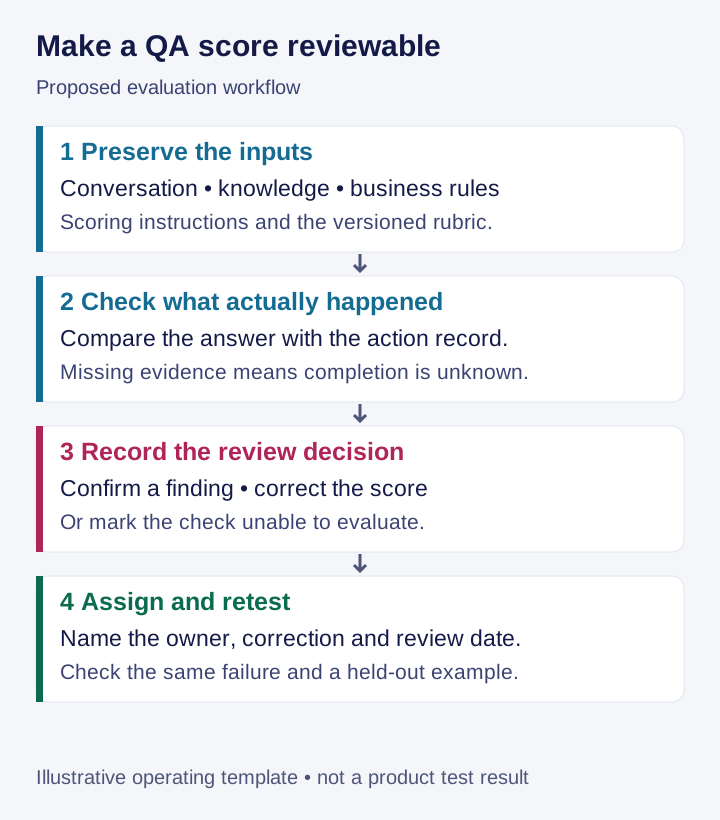
A reviewable score needs identifiable inputs: the knowledge base, applicable business rules, scoring instructions or prompts, and the deduction rubric. Keep their versions with the evaluation so a reviewer can tell which rule applied at the time.
Callnovo.ai’s HeroScore AI quality assurance offering provides scoring against configurable criteria. HeroDash’s published QA workflow supports channel-level and ticket-level evaluations, with configurable dimensions, weights and prompts. In a demonstration, ask to see how the criteria, conversation and supporting records appear together for the reviewer.
Check what the scorecard can express
Teams seeking top-rated QA tools with customizable scorecards need to test the rules that matter in their own work. For example, a refund conversation may need separate checks for identity verification, eligibility, approval authority and the accuracy of the promised update.
| Control | What to ask the vendor to show |
|---|---|
| Weighted criteria | Which points contribute to the total, and how the calculation changes |
| Critical failures | How a serious violation stays visible even when other items score well |
| Not applicable | How an irrelevant question is removed from the denominator |
| Unable to evaluate | How missing or unusable evidence is recorded without pretending the check passed |
| Version history | Which rule applied to the original score and which version is used for a retest |
| Disputed scores | The agent’s explanation, reviewer decision, evidence and change history |
A question can be not applicable because the conversation never involved a refund. It can be unable to evaluate because the refund action log is missing. Those outcomes need different labels.
Give the reviewer enough evidence
A CRM connection should expose the records needed for a check while respecting access permissions. If a score depends on whether a refund was issued or a ticket was transferred, show the relevant action evidence. A transcript saying “I’ve done that” can’t establish completion on its own.
Natural language processing can help identify topics or candidate issues in a conversation. It doesn’t remove the need to check transcription quality, context or the actual business record. Define what a reviewer should do when those sources disagree.
Use human review for disputed findings, unclear evidence and consequential judgments. AI quality assurance can assist with coverage and prioritization; replacing every reviewer would also remove the process for deciding whether the automated result is wrong.
| Part of a hybrid interaction | What the QA review should examine |
|---|---|
| Automated response | Whether the answer followed the applicable knowledge and permitted actions |
| Human decision | Whether the agent used the correct authority, explanation and next step |
| Handoff | Whether the pending issue, relevant context and responsibility reached an accepting owner |
Run four failure tests before rollout
A complete summary can still contain an unauthorized question or describe an action that never happened. Test those errors directly before relying on automated scoring.
NIST’s Generative AI Profile, AI 600-1, recommends comparison with known ground truth and multiple evaluation methods in action MP-2.3-001. Action MS-2.3-002 calls for empirical validation of capability claims. Apply that principle by giving the vendor a test packet with an agreed policy, a conversation and known action records.
The following four fixtures are hypothetical buyer-run tests. They are examples to adapt and execute, not product test results. Keep the expected outcomes with your reviewers until the vendor has returned its results.
Test 1: complete fields, unauthorized extra question
Policy: For this test, a refund inquiry requires an order reference and purchase email. The assistant is not authorized to request identity documents.
Customer message: “Please check whether my order is eligible for a refund.”
Generated response: It requests both permitted fields, then asks the customer to upload a passport image.
Expected review: Record that the required fields are present and separately flag the unauthorized request. A completeness score must not conceal a data-collection violation. Use synthetic data throughout the test.
Test 2: a transfer claim without a transfer
Known action record: The test system shows that no transfer was executed, and the original owner remains assigned.
Generated response: “I’ve transferred your case to the refund team.”
Expected review: Flag a claim that conflicts with the known action record. In a second version of the test, withhold the action log. The result should then be unable to evaluate completion, followed by a request for evidence. A missing log alone does not prove that the transfer never happened.
Test 3: a request becomes an approval
Policy: Refund approval requires an authorized reviewer. The fixture contains no approval.
Customer message: “I would like a refund. Can someone review this?”
Generated summary: “Refund approved; customer awaiting payment.”
Expected review: Preserve the customer’s request as pending and flag the unsupported approval. Test whether the software detects the change in meaning, even though the summary contains the words “refund” and “customer.”
Test 4: the unresolved deadline disappears
Conversation record: The customer needs an update before a travel departure. The team has agreed to provide a status update at 3 p.m. Eastern on the next business day; approval is still pending.
Generated handoff: “Refund inquiry received. Order located.”
Expected review: Flag the missing update commitment and unresolved approval. The corrected handoff should retain the next update, the accepting owner and the decision still required, without promising that the refund itself will be completed by that time.
Run the tests in each important channel and service language, using reviewers who can assess the content. Add examples of poor audio, an unavailable business record and a policy version change. Ask whether the system can distinguish a scoring error from an integration failure and whether it preserves enough evidence to reproduce the result.
Record the fixture ID, policy version, expected result, actual output, supporting evidence, reviewer decision and retest result. Leave an unexecuted test unscored.
Turn review into coaching and follow-up
Calibration means that reviewers compare evaluations of the same conversation and resolve differences in how they apply the rubric. Start with an independently scored set, discuss disagreements at the individual criterion level and keep the agreed rationale.
For a hypothetical known-failure set containing 20 genuine violations, suppose the software flags 18 of them and also flags 7 acceptable conversations. Recall is 18/20, or 90%; precision is 18/25, or 72%. The first measures how many known violations it found; the second measures how many flags were correct. Those are example calculations, not acceptance thresholds or vendor results.
Check unflagged conversations as well as flagged ones. Reviewing only alerts won’t reveal the violations the system missed. Keep results separated by relevant channel, language and issue type so a good aggregate score doesn’t hide an important weak area.
For ticket quality assurance, include whether the customer’s issue stayed unresolved across contacts. Pair a QA finding with the corresponding customer satisfaction feedback or repeat contact when available, without assuming that either measure proves the cause.
| Accepted finding | Corrective action | What closes the review |
|---|---|---|
| An agent used an outdated policy | Correct the knowledge source and coach the affected step | A later evaluation uses the correct version |
| A summary turned a request into approval | Fix the generation/scoring instructions and test authority boundaries | The same fixture and a held-out variant return the expected status |
| A handoff lost the next update | Change the handoff fields and acceptance procedure | The receiving owner can identify the pending task and commitment |
| Reviewers disagree on an ambiguous criterion | Clarify the rubric and recalibrate | Reviewers can apply the revised rule with an explained decision |
The best tools for identifying support quality gaps make the finding actionable. Name the owner, correction and review date; then check whether the problem recurs. A completed coaching task alone doesn’t demonstrate that service improved.
Compare the full cost and operating responsibility
To compare affordable QA software for call centers, use the same volume, channels, languages and review workload in each quote. Ask what is included in the platform price and what changes as usage grows.
| Cost or responsibility | What to include in the comparison |
|---|---|
| Platform and usage | Seats, minutes or conversations, minimum commitments and billing term |
| Data access | Integration work, transcription, storage, retention and export charges |
| Evaluation setup | Rubric design, policy maintenance, language configuration and calibration |
| Human review | Time for appeals, uncertain results, known-failure testing and unflagged sampling |
| Corrective work | Coaching, knowledge updates, automation changes and follow-up evaluations |
Callnovo.ai’s pricing page lists Omnichannel AI QA at US$30 per agent per month as an add-on. It also describes platform charges, billing terms and a live-agent arrangement in which four add-ons are included. Treat the US$30 line as one component of the applicable arrangement, and compare the full quote for your setup.
If you’re replacing manual QA scorecards, decide which work will move into the software and which person will still own review. Customer service QA software can organize the record; you still need an agreement on who resolves a dispute and who changes the process afterward.
For an outsourced or multilingual team, ask to review a completed evaluation in each relevant language. Company-wide language coverage doesn’t establish who is qualified to assess your particular conversations. Keep a client-side route for findings involving your policies or approval limits.
Also inspect access controls, retention, export, recording consent and the intended use of employee data. Ask exactly what an emotion or sentiment feature measures and which inputs it uses; obtain the appropriate privacy and legal review for the jurisdictions and workplace use involved. A marketing label doesn’t determine whether that use is permissible.
Three questions before you sign
- Can an agent and reviewer explain the score from the same evidence? If they can’t identify the relevant rule, conversation and action record, improve the evidence path before relying on the number.
- Does the tool pass your known-outcome tests? If you have only a vendor demo, run your own fixtures and record both mistakes and unable-to-evaluate results.
- Who acts on an accepted finding? If no owner, correction or review date is attached, the result can sit in a dashboard without changing the next conversation.
Bring those questions and a permitted sample to a call center quality assurance software demonstration. For Callnovo.ai, start with HeroScore and ask to walk through the score, review decision and follow-up on the same case.