

Answering Service Pricing: Per-Minute, Per-Call, Flat-Rate and Per-Resolution Costs Compared
Answering service pricing compared: per-minute, per-call, flat-rate, pay-as-you-go and per-resolution billing, with one month of calls priced five ways.
Este artículo está actualmente disponible solo en inglés.Ver en inglés →
Answering service pricing looks simple on a plan card: a monthly fee and a number of minutes or calls. The bill you actually get depends on two things the card doesn’t show. One is the unit you are charged for. The other is how your own calls fit that unit: how many there are, how long they run, and how many are junk.
This guide lists what providers publish, explains the five billing units in use, and prices the same month of calls under each one. All prices are in US dollars and were read from each company’s own pricing page or billing terms on November 18, 2026.
How much does an answering service cost per month?
Your monthly answering service cost is the billing unit multiplied by your call pattern, so there is no single typical price. Each provider’s lowest published plan starts anywhere from $44 a month plus per-minute usage (Specialty Answering Service) to $350 a month for 200 minutes (AnswerConnect). The table shows two plans from each of six providers. Virtual receptionist plans are quoted the same way, so the same columns apply to them.
| Provider | Plan | Monthly fee | Included | Extra usage | Billing increment |
|---|---|---|---|---|---|
| Ruby | 50 minutes | $250 | 50 receptionist minutes | Not published | 30 seconds, rounded up |
| Ruby | 100 minutes | $395 | 100 receptionist minutes | Not published | 30 seconds, rounded up |
| Smith.ai (live receptionists) | Starter | $300 | 30 calls | $11.50 per call | Per call |
| Smith.ai (live receptionists) | Basic | $810 | 90 calls | $10.50 per call | Per call |
| AnswerConnect | Entry | $350 | 200 minutes | $2.50 per minute | 1 minute, rounded up |
| AnswerConnect | Growth | $395 | 300 minutes | $1.85 per minute | 1 minute, rounded up |
| PATLive | Pay as you go | $49 | No minutes | $2.99 per minute | First minute in full, then 6 seconds |
| PATLive | 200 minutes | $349 | 200 minutes | $1.99 per minute | First minute in full, then 6 seconds |
| Specialty Answering Service | Economy | $44 | No minutes | $1.54 per minute | 1 second |
| Specialty Answering Service | 100 minute | $159 | 100 minutes | $1.44 per minute | 1 second |
| MAP Communications | Pay As You Go | $49 | 0 minutes | $1.37 per minute | Not published |
| MAP Communications | Business | $179 | 125 minutes | $1.30 per minute | Not published |
Divide each fee by its allowance and the answering service rates spread out further. An included minute works out to $5.00 on Ruby’s 50-minute plan ($250 ÷ 50) and about $1.32 on AnswerConnect Growth ($395 ÷ 300). Smith.ai’s Starter plan works out to $10 per call ($300 ÷ 30).
If you are asking how much does an answering service cost compared with hiring, start from government wage data. The Bureau of Labor Statistics reported these mean wages for May 2025 (BLS, 2025):
- Receptionists and information clerks: $18.97 an hour, or $39,460 a year. That is about $3,288 a month in wages alone.
- Customer service representatives: $22.40 an hour, or $46,590 a year.
Wages are not the whole cost of an employee. Across private industry, benefits made up 30.0% of employer compensation costs in June 2026 (BLS, 2026).
An in-house hire buys one person for fixed hours. An answering service buys handled calls or minutes. Which costs less depends on how many calls you get and when they arrive, which is what the rest of this guide helps you work out.
Five ways answering services bill
Every plan in the table above charges for one of five units. Live receptionists and AI agents now answer phones side by side, and both are sold on these same units.
| Billing model | What you pay for | Published example | The bill rises when | Fits |
|---|---|---|---|---|
| Per-minute | Each minute of handling time, at one rate | Callnovo.ai lists phone support at $1 per minute and its AI Receptionist at $0.15 per minute | Calls run long, or time is rounded up | Short calls with predictable length |
| Per-call | Each call handled, whatever its length | Smith.ai live receptionists: Basic, 90 calls for $810, then $10.50 per call | Call count grows, including calls you would not have answered yourself | Long intake or consultation calls |
| Flat-rate bundle | A fixed monthly fee for a set allowance, plus overage | AnswerConnect Growth: 300 minutes for $395, then $1.85 per minute | You exceed the allowance, or leave it unused | Steady monthly volume |
| Pay-as-you-go | A small base fee, then every minute at a higher rate | PATLive: $49 a month plus $2.99 per minute | Volume grows past the point where a bundle is cheaper | Low or irregular volume |
| Per-resolution | Each customer issue that is resolved, on any channel | Callnovo.ai: $0.79 to $6.99 per resolution, by complexity | Issues get more complex, or more of them are resolved | Repeat questions across phone, chat and email |
Most of the live plans in the first table bill by the minute. AI answering can be billed by the minute too, at a much lower rate. The AI answering service rate on Callnovo.ai’s pricing page is $0.15 per minute, and the same page says each bot carries a $200 monthly minimum.
Answering service per call pricing removes the clock. Smith.ai charges per call for both its live and AI receptionists. Its AI Receptionist Pro tier starts at 75 calls for $150 a month, or $2.00 per call.
A plan advertised as a flat rate answering service or flat fee answering service is, in the plans above, a bundle: the fee is fixed and so is the allowance. Use beyond it is billed as overage. A pay as you go answering service turns that around. The base fee is low and nothing is included, so every minute is billed.
Per-resolution billing counts finished customer issues instead of minutes or calls. That lets one unit cover phone, chat and email. Our customer service outsourcing guide covers the same units across a full support program, and our guide to email support outsourcing costs applies them to an email queue.
Software vendors already publish prices on this basis. Intercom prices its Fin AI agent at $0.99 per outcome. Zendesk lists automated resolutions at $1.50 each on a committed plan or $2.00 pay-as-you-go. Salesforce lists Agentforce at $2 per conversation.
For its pay-per-resolution service, Callnovo.ai’s pricing page publishes three tiers:
- Simple, $0.79 to $1.49: FAQs, order status, password resets.
- Standard, $1.50 to $3.49: returns, billing, troubleshooting.
- Complex, $3.50 to $6.99: technical support, escalations, multi-touch issues.
Prices are 10% lower at 500 to 2,000 resolutions a month and 20% lower above 2,000. A minimum monthly commitment applies.
Billing rules to confirm before you sign
Two providers can charge for the same unit and still send different bills. Six rules explain the difference, and each one is a question you can put to a provider before signing.
| Rule | Why it changes the bill | What to ask |
|---|---|---|
| Billing increment | Rounding adds billed time to every call | “What increment do you bill in, and do you round up?” |
| Hold and transfer time | Minutes can keep running while the caller waits or is connected to you | “Does billing cover hold time, and when does it stop on a transferred call?” |
| After-call work | Message entry after the caller hangs up may be billed | “Is the time spent writing up the message billed?” |
| Spam and wrong numbers | Calls with no business value can use up your allowance | “Which calls are excluded, and do I have to do anything to exclude them?” |
| After-hours and holidays | Some plans price nights, weekends or holidays differently | “Is there any extra fee for overnight, weekend or holiday calls?” |
| Unused allowance | Unused minutes or calls may expire each cycle | “Do unused minutes roll over?” |
Billing increment. Take a call that lasts 1 minute and 25 seconds:
- AnswerConnect rounds calls longer than 30 seconds up to the whole minute. Its own example says that call uses 2 minutes.
- Ruby rounds up to the next 30-second mark, which makes it 1 minute 30 seconds.
- Specialty Answering Service bills by the second, so it stays at 1 minute 25 seconds.
- PATLive bills the first minute in full and then in 6-second increments.
Hold and transfer time. Ruby’s billing FAQ says receptionist minutes include time the caller is on hold, and that billing stops once the call is transferred to you or to voicemail. Specialty Answering Service lists patching, its term for connecting the caller to you, at $0.10 per minute from connect until disconnect. AnswerConnect says it does not charge for queue time before a receptionist answers.
After-call work. AnswerConnect counts the after-call work its receptionists do to process your message as part of your minutes. PATLive says it does not charge for after-call notes, message entry or wrap-up.
Spam and wrong numbers. Unwanted calls are common enough to plan for. The FTC’s Do Not Call Data Book for fiscal year 2025 shows about 2.6 million complaints, about 1.6 million of them about robocalls (FTC, 2025). Providers handle these calls differently. Smith.ai says its live receptionist plans do not charge for spam or unsolicited sales calls as long as the lines you forward pass Caller ID.
After-hours and holidays. PATLive’s FAQ says there is no extra charge for overnight, weekend or holiday calls. Ruby’s pricing page says it has no additional fees for activation, onboarding, setup, customization or coverage during certain periods. If most of your calls arrive outside business hours, see how after-hours answering coverage is scoped.
Unused allowance. Ruby, AnswerConnect and PATLive each state that unused minutes do not roll over to the next billing period.
One month of calls priced five ways
The table below is a worked example, not a quote. It applies published prices to one invented month so you can see how the units behave, then repeats the sums with longer calls.
Assumptions for Month A:
- 150 inbound calls.
- 20 of them are spam, wrong numbers or hang-ups, lasting 20 seconds each.
- 130 real calls, each taking 2 minutes 30 seconds of handling time, including any after-call work.
- 39 of the real calls (30%) need a person. Where AI answers first, it hands those calls over after 1 minute.
- Each real call is one customer issue. 120 are resolved, 80 at the Simple tier and 40 at the Standard tier. The other 10 are not resolved.
- Where a provider’s terms do not say how junk calls are billed, the example bills them as answered time.
- Taxes, one-time setup fees and transfer charges are left out.
- Callnovo.ai’s per-resolution pricing carries a minimum monthly commitment that is set in the quote, so that row shows usage only.
| Billing model | Price used | Formula | Month A bill |
|---|---|---|---|
| Per-minute, live | Callnovo.ai phone support, $1 per minute | (325 + 6.67 minutes) × $1 | $331.67 |
| Per-minute, AI first | Callnovo.ai AI Receptionist, $0.15 per minute, $200 monthly minimum per bot, plus phone support at $1 per minute for handed-over calls | AI: 266.5 minutes × $0.15 = $39.98, so the $200 minimum applies. Live: 39 × 2.5 minutes × $1 = $97.50 | $297.50 |
| Per-call | Smith.ai Basic, 90 calls for $810, then $10.50 per call | $810 + 40 × $10.50 | $1,230.00 |
| Flat-rate bundle | AnswerConnect Growth, 300 minutes for $395, then $1.85 per minute | 130 calls × 3 minutes = 390 minutes. $395 + 90 × $1.85 | $561.50 |
| Pay-as-you-go | PATLive, $49 plus $2.99 per minute | (325 + 20 minutes) × $2.99 + $49 | $1,080.55 |
| Per-resolution | Callnovo.ai, Simple $0.79 to $1.49, Standard $1.50 to $3.49 | Low: 80 × $0.79 + 40 × $1.50. High: 80 × $1.49 + 40 × $3.49 | $123.20 to $258.80 |
How each row treats the details:
- The 130 real calls total 325 minutes of actual handling time. AnswerConnect rounds each 2 minute 30 second call up to 3 minutes, so it bills 390.
- The 20 junk calls add 6.67 minutes when billed as measured, and 20 minutes on PATLive, which bills the first minute of every call in full.
- They add nothing on three rows. AnswerConnect does not charge for the first 30 interactions under 30 seconds in a billing cycle. Smith.ai does not count them when Caller ID is passed. HeroDash’s billing terms list spam filtering as not billable.
- AI minutes are 91 calls × 2.5 minutes plus 39 calls × 1 minute. At $0.15 per minute, a bot needs about 1,333 minutes in a month to reach its $200 minimum.
Now change one thing. In Month B the 130 real calls take 6 minutes each, and the example assumes those longer calls are harder ones, so the resolved issues split 40 Simple and 80 Standard.
| Billing model | Month A | Month B | Month B formula |
|---|---|---|---|
| Per-minute, live | $331.67 | $786.67 | (780 + 6.67 minutes) × $1 |
| Per-minute, AI first | $297.50 | $434.00 | AI: 585 minutes × $0.15 = $87.75, so the $200 minimum applies. Live: 39 × 6 minutes × $1 = $234 |
| Per-call | $1,230.00 | $1,230.00 | Unchanged |
| Flat-rate bundle | $561.50 | $1,283.00 | $395 + 480 × $1.85 |
| Pay-as-you-go | $1,080.55 | $2,441.00 | (780 + 20 minutes) × $2.99 + $49 |
| Per-resolution | $123.20 to $258.80 | $151.60 to $338.80 | Low: 40 × $0.79 + 80 × $1.50. High: 40 × $1.49 + 80 × $3.49 |
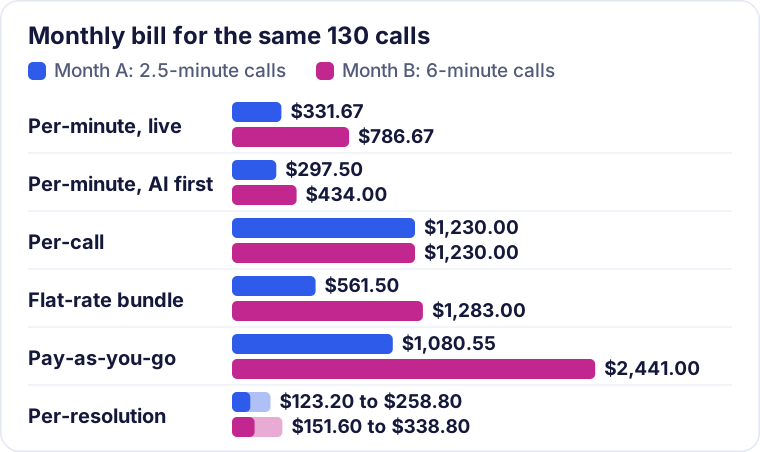
Month A and Month B bills from the two tables above. Lighter segments on the per-resolution bars show the range between the low and high tier prices.
Longer calls move the rows in different ways. The live per-minute, bundle and pay-as-you-go bills more than double, while the per-call bill does not move, so the per-call plan goes from the most expensive row to cheaper than the bundle. The AI-first bill rises less because its $200 minimum stays the same. The per-resolution bill changes only because the issues got harder, not because the calls got longer.
These plans do not buy identical service. Who answers, which hours are covered and what the person or AI can do on the call differ from provider to provider, so read the table as billing arithmetic. Callnovo.ai’s rates come from its published pricing; a quote for your project will set the unit, any minimum and the scope.
What counts as a resolution
A per-resolution bill is only as predictable as the definition behind it. Callnovo.ai’s pay-per-resolution page states the principle: only successful resolutions are billed, a resolution is a customer’s issue that has been fully addressed and closed, and a follow-up on the same issue is still one resolution.
For work the AI handles, the detailed rules come from the AI billing guide published by HeroDash, the platform Callnovo.ai runs on. Those terms cover AI-handled conversations. For work handled by people, the billing unit is the one written in your order.
| Item | How the HeroDash AI terms treat it |
|---|---|
| Keypad or menu IVR, business-hours checks, spam filtering, deterministic number routing | Not billable as AI usage |
| A digital-channel customer who immediately asks for a human, before substantive AI work begins | Not billable as AI usage |
| Several questions answered in one conversation | At most one outcome per conversation, unless the contract defines separate workflows |
| A conversation reopened inside the review window because the issue was not actually resolved | The original outcome is reversed or credited |
| A handoff to a person | Not a verified outcome. AI work done before the handoff can still be billed as usage |
| Changing the billing model after results are known | The same traffic cannot be repriced retrospectively |
The handoff row matters most for your forecast. Callnovo.ai’s pay-per-resolution page says that for HeroDash AI, usage billing and outcome billing are separate commercial models. AI work performed before a handoff may be billable under a usage plan even when the handoff does not qualify as a verified outcome.
The guide also limits what can change later. It calls itself the public baseline and says an order form can add workflow-specific verification but cannot silently broaden the billable unit after signing.
Definitions differ between vendors, so compare them line by line. Intercom’s help center says a resolution is counted when the customer confirms the answer was satisfactory, or when the customer leaves the conversation without asking for further help. It calls the second case an assumed resolution, and it is charged. A customer who explicitly asks for a human agent is not billed as an outcome.
Before you agree to per-resolution pricing with any provider, get four things in writing:
- The definition of a resolution, and who or what verifies it.
- The list of interactions that are never billed.
- What you pay when the AI works on an issue and then hands it to a person.
- The reopen window, and whether a reopened issue is credited.
Which pricing model fits your call pattern
Start from your calls, then pick the unit.
| Your call pattern | Look first at | Switch when |
|---|---|---|
| Low volume that varies month to month | Pay-as-you-go, or per-resolution if most calls are simple repeat questions | Your minutes regularly pass the point where a bundle costs less |
| Steady volume, short calls | A flat-rate bundle sized just above your normal month, on the smallest increment you can get | You pay overage most months, or leave a large part of the allowance unused |
| Long calls, or the same questions on phone, chat and email | Per-call for long phone intake; per-resolution for repeat issues across channels | Call count climbs faster than call length, or the issue mix moves to higher tiers |
The switch point for the first row is simple to work out. PATLive’s pay-as-you-go plan costs $49 plus $2.99 per minute, and its 200-minute plan costs $349. The two cost the same at about 100 minutes ($349 − $49 = $300, and $300 ÷ $2.99 ≈ 100). Below that, pay-as-you-go is cheaper. Run the same sum with the plans you are quoted.
If your volume is low, minimums and base fees matter more than rates. The Month A example shows it: 266.5 AI minutes cost $39.98 at the listed rate, and the $200 minimum set the bill. Our comparison of outsourcing companies by minimum commitment looks at minimums in outsourced support contracts.
When you compare flat rate answering service companies, line up three numbers for each one: the allowance, the overage rate and the billing increment.
A shared team for a monthly fee is another form of bundle. Callnovo.ai’s pricing page lists a live shared team from $650 a month including 1,500 minutes. The same page says standard projects use non-shared agents, and that a shared arrangement can be assessed for special requirements such as low-volume, backup or overflow coverage. Shared and dedicated agents suit different workloads, and our answering service options for small businesses page lists the choices side by side.
Your next step takes three items. Pull your last three months of call records and note the call count, the average length and the share of junk calls. Put those numbers into the Month A table in place of the example. Then take the six questions from the billing rules section to each provider and ask for the answers in a written quote.
References
Provider prices and terms were read on November 18, 2026.
- U.S. Bureau of Labor Statistics — Occupational Employment and Wages, May 2025: Receptionists and Information Clerks (43-4171)
- U.S. Bureau of Labor Statistics — Occupational Employment and Wages, May 2025: Customer Service Representatives (43-4051)
- U.S. Bureau of Labor Statistics — Compensation costs for private industry workers averaged $46.89 per hour worked in June 2026 (September 17, 2026)
- Federal Trade Commission — Do Not Call Data Book 2025
- Ruby — Plans and pricing
- Ruby — Billing FAQs (2021)
- Ruby Help Center — Robocall filtering (July 31, 2026)
- Smith.ai — Receptionist pricing
- Smith.ai — AI Receptionist pricing
- AnswerConnect — Plans
- AnswerConnect Help Center — How are my minutes calculated for billing?
- PATLive — Pricing
- PATLive — FAQs
- Specialty Answering Service — Pricing
- MAP Communications — Pricing
- Intercom — Pricing
- Intercom Help Center — Fin AI Agent outcomes
- Zendesk — Pricing
- Salesforce — Agentforce pricing
- Callnovo.ai — Pricing
- Callnovo.ai — Pay per resolution
- HeroDash — AI billing guide (linked in the section on what counts as a resolution)
Lo que preguntan los compradores
- Is a flat-rate answering service really unlimited?
- Not in the plans listed in this article. Each flat monthly fee buys a set number of minutes or calls, and use above that number is billed at the plan's overage rate. AnswerConnect Growth, for example, includes 300 minutes for $395 and charges $1.85 for each additional minute. Ask any provider that advertises a flat rate what the allowance is and what happens when you pass it.
- How is AI answering priced compared with live answering?
- AI answering is sold on the same units at lower rates, and it can carry a monthly minimum. Callnovo.ai lists its AI Receptionist at $0.15 per minute with a $200 monthly minimum per bot, and live phone support at $1 per minute. Smith.ai's AI Receptionist Pro tier is $2.00 per call at 75 calls a month, while its live Starter plan is $300 for 30 calls. Check what you pay when the AI passes a call to a person, because both the AI time and the live time can be billed.
- Do answering services charge for spam or wrong-number calls?
- It depends on the provider and sometimes on your setup. Smith.ai does not charge its live receptionist plans for spam or unsolicited sales calls when the forwarded line passes Caller ID. On its AI Receptionist, every answered call counts toward the quota by default, and customers can remove up to 10% of calls from each billing cycle for selected spam. Ruby turns on robocall filtering at the customer's request, and filtered calls do not count toward billable minutes. AnswerConnect does not charge for the first 30 interactions under 30 seconds in each billing cycle.